Is Lisbon Walkable?
Is Lisbon walkable? A straight answer on the hills, the flat neighbourhoods, the lifts and funiculars, and which free walking tours suit slower walkers.
Yes, Lisbon is walkable, and most visitors walk it. The city sits mostly below 100 metres, but its centre climbs several real hills, including the Castelo, Graça and Senhora do Monte slopes, with a maximum of 230 metres at the Monsanto ridge. The flat Baixa grid, the riverside and the miradouros are all reachable on foot, and the steep parts can be skipped using the lifts, the reopened Graça funicular and the tram.
That is the short version. The longer version matters, because "walkable" means two different things in Lisbon. The first is distance: the historic centre is compact, and the walks between its squares and viewpoints are short. The second is gradient: Lisbon's oldest neighbourhoods sit on hills, and the streets that connect them are steep, cobbled and, in places, worn smooth.
This article takes the question apart piece by piece. It covers what the hills actually do to a day on foot, which neighbourhoods let you walk flat, what the lifts and funiculars are doing right now, which surfaces turn slippery in the rain, and which of the city's free walking tours suit a slower pace. The free walks named here are all free, pay what you want, reserved on their platforms, and this site is not affiliated with any of them.
Is Lisbon Walkable For A Visitor?
Yes, with planning. A visitor can walk between Praça do Comércio, the Baixa grid, Chiado and the riverside entirely on the flat, and the Alfama and Graça hills are walkable climbs with rest points at the miradouros. The city's free walking tours, 63 of them listed across GuruWalk and freetour.com, all run on foot, which tells you the format works. The catch is footwear and gradient, not distance.
The scale of the city helps. Lisbon's historic core is small enough that a day of sightseeing on foot is normal, and the free walking tour economy is built on exactly that. Walks like the Essential History, Free Tastings tour by Tours Of My Life, rated 4.96 out of 5 across 25,140 GuruWalk reviews, run for 3 hours from Praça Luís de Camões, entirely on foot. A city that cannot be walked does not support a roster like that.
What trips people up is not the mileage. It is the vertical. The walk from the river up into Alfama or from Baixa up to Bairro Alto is a genuine climb, on stone, in whatever the weather is doing. Visitors who plan around the hills, using the flat grid for the long stretches and the lifts or funiculars for the climbs, rarely report a problem. Visitors who treat the map like Amsterdam often do.
The good news is that the climbing is optional in a way it is not in some hill cities. The viewpoints, squares and riverside that most people come for are either free public spaces reachable on gentle gradients, or reachable with mechanical help. The ticketed sights, like São Jorge Castle at EUR 17, sit on the hills, but the streets around them cost nothing to walk.
If you want a walking-first plan, the free tours are the easiest way to get one started. These are the walks to start with:
All are free, pay what you want, and each is reserved on its own platform, GuruWalk for the first two and freetour.com for the Original Local, 3 Hours walk.
How Steep Are The Hills?
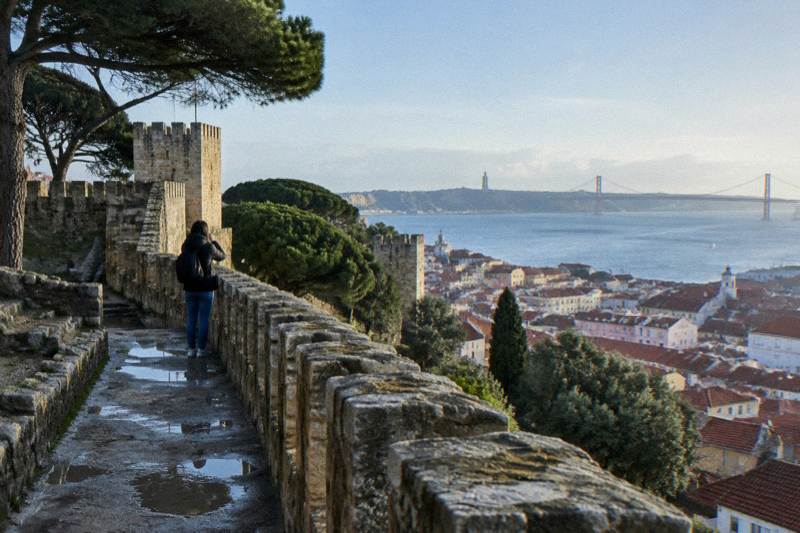
Steep enough to plan around, not steep enough to avoid. Lisbon sits mostly below 100 metres, with named central hills at Castelo, Graça and Senhora do Monte and a citywide maximum of 230 metres at the Monsanto ridge, per the city's own planning characterisation. The gradients are short and sharp rather than alpine, and the calçada stone underfoot adds its own challenge on slopes.
The city's own planning report describes the relief plainly: mostly under 100 metres, with the high point at Monsanto. What that means at street level is that the climbs are concentrated. You are either on the flat Baixa grid, rebuilt on a rational plan after the 1755 earthquake, or you are on a hill street that goes up in a hurry. There is very little in between.
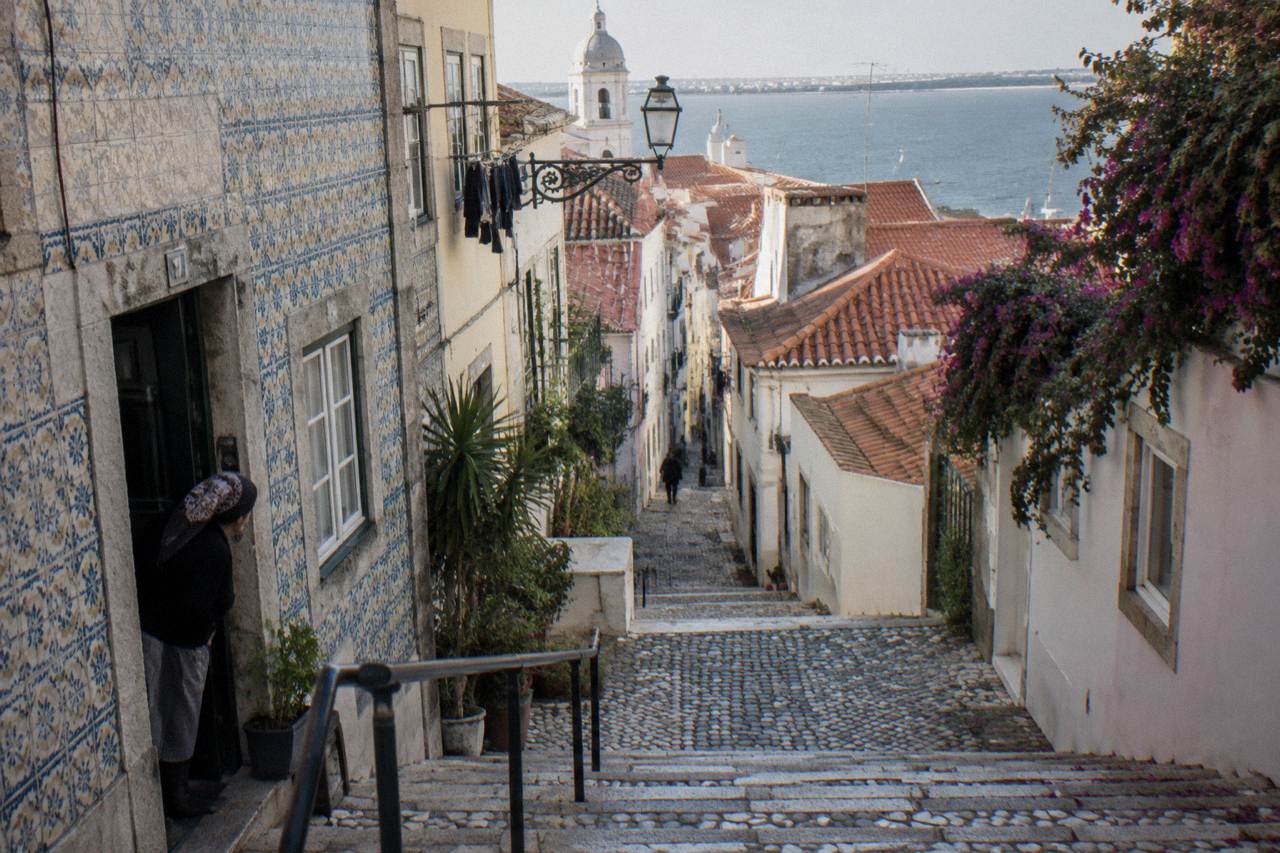
The stone matters as much as the slope. Lisbon's pavements are calçada portuguesa, white limestone and black basalt cubes laid by hand, and the first decorative example dates to 1842, inside the Castelo de São Jorge. It is beautiful. It is also laid on slopes, and hand-laid cubes polished by more than a century of feet are a different surface in the rain than in the dry. The city has repaved Rua da Madalena with new stone specifically to improve grip, which tells you the issue is real and known.
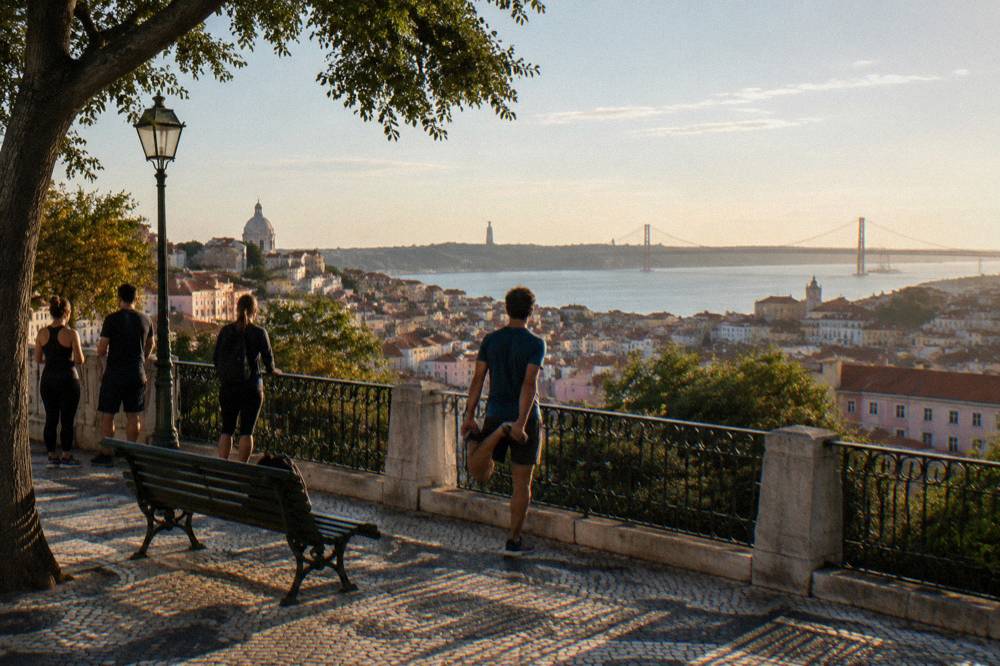
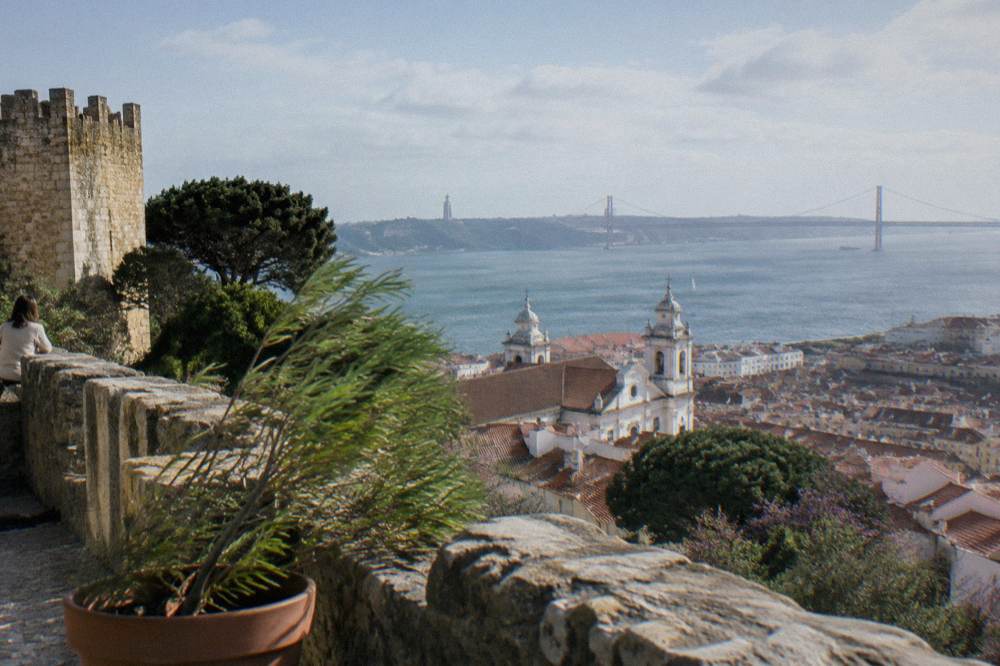
None of this makes Lisbon unwalkable. It makes Lisbon a city where the answer to "can I walk it?" is "yes, and here is where the climbs are". The hills are also where the free viewpoints live. The miradouros at Santa Catarina, Santa Luzia and Graça are free public spaces, and the walk up to them is part of what you get for the effort. The Graça viewpoint is listed open 24 hours on the city's own site.
For the climbs you would rather not do on foot, the city has mechanical options, and their current state is genuinely useful to know before you plan.
Which Neighbourhoods Are Flat?
The Baixa grid is the flat heart of the city: the rebuilt post-1755 street plan between Praça do Comércio and Rossio, level, geometric and free to walk. The riverside is flat too, including the Ribeira das Naus promenade with its steps and kiosk. Alfama, Graça, Bairro Alto and Mouraria are the hill neighbourhoods, and Chiado sits partway up the slope from Baixa.
Baixa is the answer most visitors want. After the 1755 earthquake destroyed the royal palace quarter, the city was rebuilt on a grid, and that grid is still the flattest walking in central Lisbon. Praça do Comércio, rebuilt from 1756 on the site of the destroyed Paço da Ribeira, the Rua Augusta passage under the arch, and the streets around Rossio are all level. Walking through the Rua Augusta Arch is free, and the square itself is an open public space.
The riverside continues the flat ground. The Ribeira das Naus promenade links the Cais das Colunas at Praça do Comércio towards Cais do Sodré, with broad steps, a kiosk and outdoor seating, and the city's own visitor pages call it the place for the best sunset in the city. Bathing is forbidden, but sitting and walking are the point.
Chiado, uphill from Baixa, is where the gradient starts. It is a gentle start, and it is where several of the free walking tours meet. The Essential History, Free Tastings walk by Tours Of My Life meets at Praça Luís de Camões, at the top of the Baixa grid, and runs 3 hours in English and Spanish. The Old Neighborhoods And Stories walk, rated 4.92 out of 5 across 353 GuruWalk reviews, meets at the same square for 2 hours 45 minutes. Meeting points cluster there precisely because it is the flat crossroads of the centre.
Alfama and Mouraria are the opposite case. These are the hill neighbourhoods, the oldest street plans in the city, and walking them means stairs, switchbacks and stone. The reward is that the streets themselves cost nothing, and the free tours that work this ground are built for it. The Unmissable Alfama walk by Hi Lisbon Walking Tours, rated 4.78 out of 5 across 1,706 GuruWalk reviews, runs 2 hours 30 minutes from Praça do Comércio, and the Alfama And Mouraria, 3 Hours walk covers the two districts in English and Spanish from Rossio Square.
For a fuller picture of how the districts differ, the Lisbon neighbourhoods guide breaks down each area, and the Alfama guide covers the hill district in detail.
How Do The Free Lifts And Tram Help?
Partly, and less than they used to. The Santa Justa lift and the Glória, Bica and Lavra funiculars are all out of service with no reopening date, so they cannot be counted on. The Graça funicular reopened on 30 April 2026 and runs daily at EUR 4.30 for two trips, and Tram 28 is a paid ride at EUR 3.30 on board.
The lift situation is the single biggest change to how walkable Lisbon feels right now, so it deserves precision.
| Mechanism | Status | Fare | Notes |
|---|---|---|---|
| Graça funicular (Mouraria to Graça) | Running, reopened 30 April 2026 | EUR 4.30 for 2 trips on board | Daily 07:00-21:00, Navegante pass accepted |
| Santa Justa lift | Out of service, viewpoint closed | n/a | Carris marks it temporarily closed |
| Glória funicular | Out of service | n/a | Substitute bus 51E |
| Bica funicular | Out of service | n/a | Substitute bus 22B |
| Lavra funicular | Out of service | n/a | Substitute bus 19B |
| Tram 28 | Running | EUR 3.30 on board, EUR 1.72 with Zapping | Paid ride, not a free attraction |
The closures follow the Glória accident of 3 September 2025 and the safety inspections that followed, and Carris, the operator, publishes the status on its own funiculars page. The practical effect is that the classic shortcut from Baixa up to Bairro Alto, the Glória funicular, is currently a bus, and the Santa Justa lift is not a lift you can ride.
The Graça funicular is the good news story. It reopened on 30 April 2026 after safety certification, runs daily from 07:00 to 21:00, and carried over 3,600 people in its first two weeks. It connects the Mouraria side to Graça, which is one of the steepest useful climbs in the centre. The Mouraria route also uses public escalators from the Martim Moniz area, which cost nothing to ride.
The free public lifts deserve a mention with a caveat. The city describes municipal public elevators on the Baixa-Castelo route, at Rua dos Fanqueiros and Rua da Madalena and at Chão do Loureiro, averaging 60,000 entries and exits a month. A city publication has described them as free public elevators running daily, but the current hours are not published on a current official page, so check on the day. The city's accessibility page on the Castelo hill is the source for the route.
Tram 28 is not a lift, but people ask about it as one. It is a paid ride, EUR 3.30 on board, EUR 1.72 with Zapping, and it climbs through the hills between Martim Moniz and Campo de Ourique. The Tram 28 route guide covers the line and the free walk along it, and Carris has issued service alterations during works, so check the current operation before relying on a specific stretch.
Which Streets Are Slippery In The Rain?
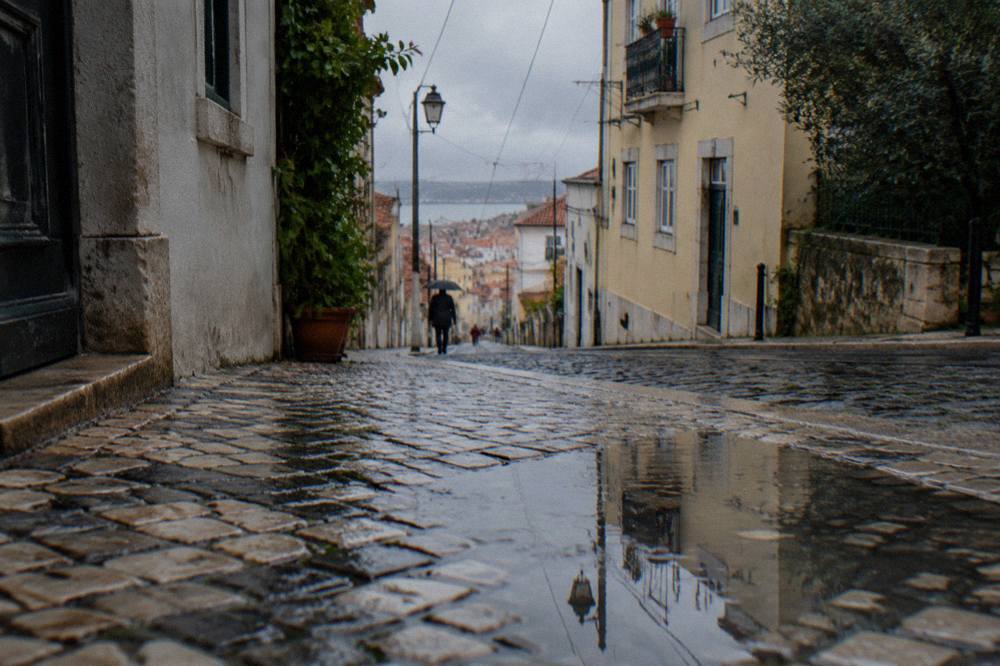
The polished calçada portuguesa on slopes, especially in Alfama, on the way up to the Castelo hill and on any hill street. The hand-laid limestone and basalt cubes become slick when wet, and the city itself repaved Rua da Madalena to improve grip. Flat Baixa is easier, but the same stone is everywhere, so shoes with grip matter more in Lisbon than in most flat capitals.
The surface is the thing to respect. Lisbon's pavements are cubes of white limestone and black basalt, laid by hand, and the first decorative example, from 1842, is inside the Castelo de São Jorge. On slopes, under rain, polished by use, this surface is genuinely slippery, and the city's own visitor pages describe the paving as becoming polished and slippery with use, especially on slopes. This is not traveller folklore; it is the official description.
The practical advice follows from the surface. Wear shoes with actual tread. Take the hills slowly in the wet. Use handrails where they exist. And when the rain is heavy, the flat grid and the indoor free options are the better plan: the Museu do Dinheiro, in the former church of São Julião, is free to enter and open Wednesday to Sunday, and the free-entry windows at the Gulbenkian and the University of Lisbon museums on Sunday mornings have no residency condition printed. The rainy day article lists them all.
One more thing worth knowing: the rain in Lisbon is seasonal and measurable. December averages 108.5 mm of rain over 10 days with 1 mm or more, and November is the wettest month at 133.9 mm, per the national weather service's 1991-2020 normals. Summer months are dry by comparison. The slippery-street problem is mostly a November-to-March problem.
Which Free Walks Suit Slower Walkers?
The shorter ones, and the ones that meet on the flat. The Local's Eyes Walk, 1 Hour 30 by Francisco, rated 4.93 out of 5 across 350 GuruWalk reviews, runs just 90 minutes from Rossio Square. The SANDEMANs Original Walk on freetour.com runs 2 hours from Praça do Comércio, rated 9.4 out of 10 across 14,048 freetour.com reviews. The hill walks, like the Top 8 Miradouros Walk at 3 hours, demand more legs.
Duration is the honest proxy for effort here, because every free walking tour in the city runs on foot. The roster runs from 90 minutes to 4 hours, and the meeting points tell you where the walk starts climbing.
| Walk | Platform | Duration | Meets at | Rating |
|---|---|---|---|---|
| Local's Eyes Walk, 1 Hour 30 | GuruWalk | 1 hour 30 minutes | Rossio Square | 4.93 out of 5 across 350 GuruWalk reviews |
| SANDEMANs Original Walk | freetour.com | 2 hours | Praça do Comércio | 9.4 out of 10 across 14,048 freetour.com reviews |
| Baixa Chiado, 1755 Earthquake | GuruWalk | 2 hours 30 minutes | Praça do Comércio | 4.79 out of 5 across 583 GuruWalk reviews |
| Top 8 Miradouros Walk | GuruWalk | 3 hours | Praça Luís de Camões | 5 out of 5 across 1,277 GuruWalk reviews |
The SANDEMANs Original Walk is the natural pick for a walker who wants the city explained without a long day on the hills. It meets at Praça do Comércio, on the flat, runs 2 hours in English or Spanish, and is listed on freetour.com. It is free, pay what you want, like every walk on this site's roster.
For walkers who are comfortable but unhurried, the Baixa Chiado, 1755 Earthquake walk by Hi Lisbon Walking Tours covers the flat grid and the story of the quake that created it, 2 hours 30 minutes from Praça do Comércio. The earthquake story is the story of why Baixa is the walkable grid it is: the 1755 quake, tsunami and fires destroyed the riverside quarter, and the Marquês de Pombal's rebuild used earthquake-resistant timber-framed construction on a rational plan. Walking Baixa is walking the answer to the earthquake.
The miradouros walks are the demanding end. The Top 8 Miradouros Walk by Ricardo, a perfect 5 out of 5 across 1,277 GuruWalk reviews, runs 3 hours from Praça Luís de Camões, and viewpoints mean hills. The With A Native, 2 Hours 15 walk by Nuno, rated 4.93 out of 5 across 235 GuruWalk reviews, meets at the Miradouro de São Pedro de Alcântara, which starts you high and saves the climb. Choose by gradient appetite, not just by rating.
Common Questions On This Topic
Is Lisbon Walkable?
Yes. The historic centre is compact, the Baixa grid and riverside are flat, and the hills, while real, are short climbs that the lifts, the reopened Graça funicular and careful route planning can mostly bypass. Good shoes matter more than fitness.
How Hilly Is Lisbon Really?
The city sits mostly below 100 metres, with central hills at Castelo, Graça and Senhora do Monte and a maximum of 230 metres at the Monsanto ridge. The climbs are short and steep rather than long, and the flat Baixa grid sits between them.
Can I Avoid The Hills Entirely?
Largely, yes. Baixa, Praça do Comércio, Rossio and the Ribeira das Naus riverside are flat and free to walk. The Graça funicular runs daily, the Mouraria escalators from Martim Moniz cost nothing, and tram 28 is a paid ride at EUR 3.30 on board that climbs through the hills for you.
Is The Santa Justa Lift Working?
No. Carris marks the Santa Justa lift and its viewpoint as closed, and the Glória, Bica and Lavra funiculars are also out of service with no reopening date. Substitute buses 51E, 22B and 19B cover the funicular routes.
Are Lisbon's Streets Dangerous In The Rain?
The calçada portuguesa, hand-laid limestone and basalt cubes, becomes polished and slippery with use, especially on slopes, and the city repaved Rua da Madalena specifically to improve grip. Shoes with tread and a slower pace on hills solve most of it.
Which Free Walking Tour Is Easiest On The Legs?
The Local's Eyes Walk, 1 Hour 30 by Francisco on GuruWalk runs just 90 minutes from Rossio Square, and the SANDEMANs Original Walk on freetour.com runs 2 hours from flat Praça do Comércio. Both are free, pay what you want.
If the hills still feel like a lot, pick a walk that starts where you want to end. These three all suit a walking-first visit:
For everything that costs nothing in this city, Free Things To Do In Lisbon keeps the full picture, from the flat squares to the hilltop viewpoints that make the climb worth it.