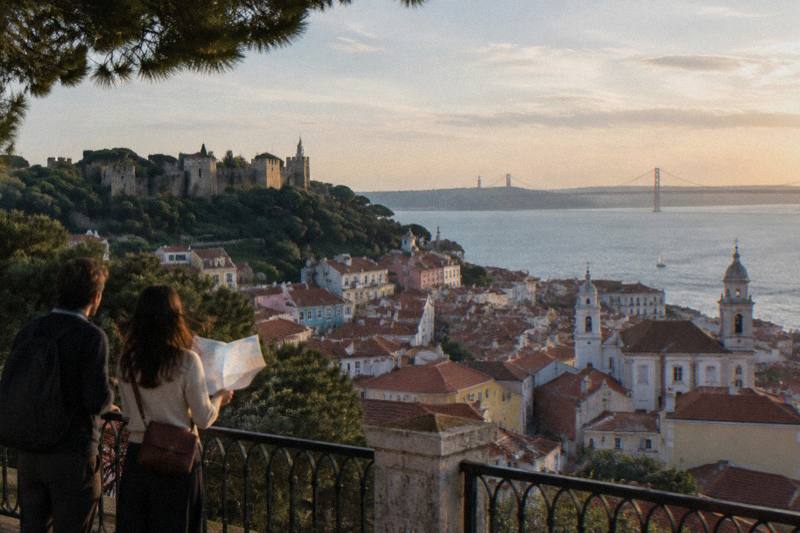
What Can Children Do For Free In Lisbon?
Free things to do in Lisbon with kids: gardens, viewpoints, squares, free museums and free walking tours, plus the child ticket rules and costs that catch families out.
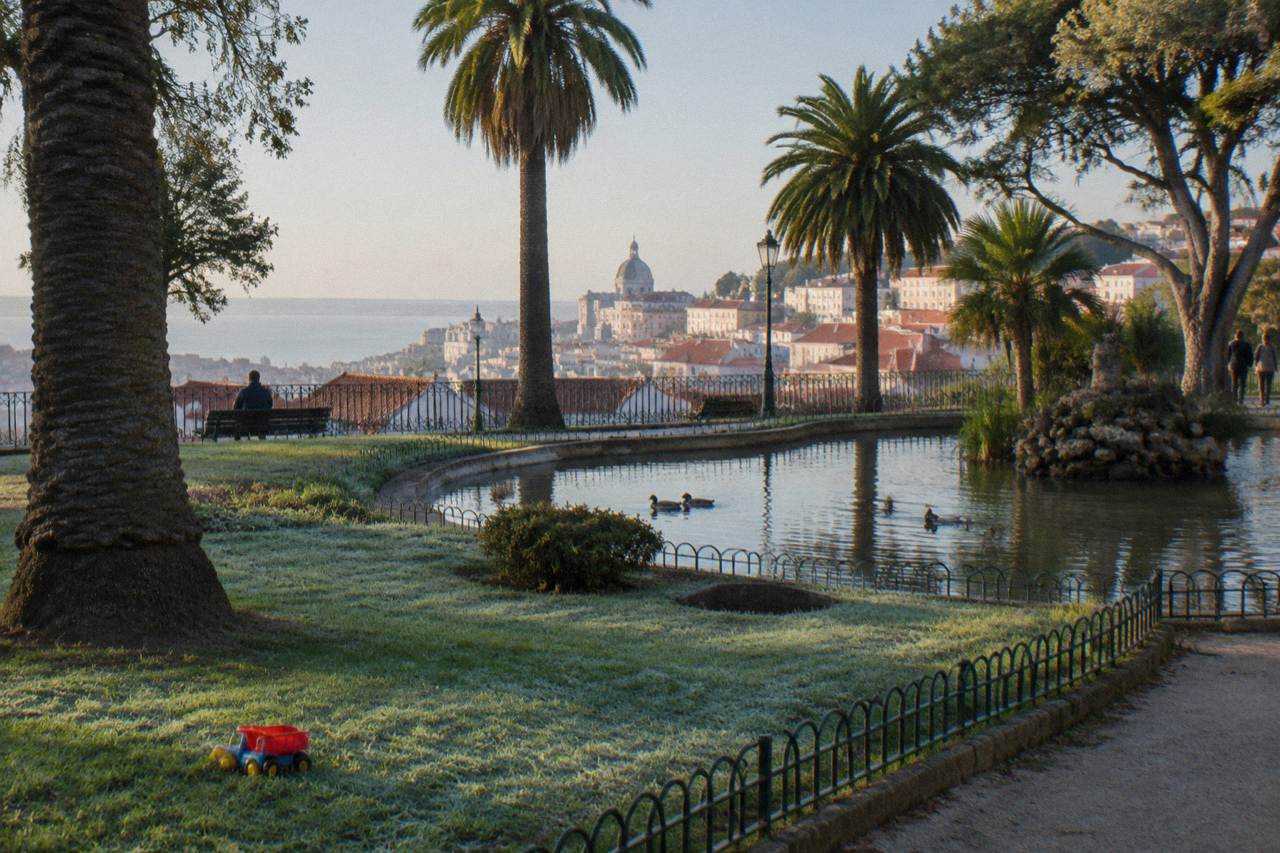
What Can Children Do For Free In Lisbon?
The honest answer is that most of what makes Lisbon fun for children costs nothing: the public gardens and squares, the miradouro viewpoints, the riverside promenades in Baixa and Belém, and the free-entry Museu do Dinheiro. On top of that, children get real discounts at paid sites, with under-13s free at the Jerónimos Monastery cloister, Belém Tower and MAAT, under-12s free at the Museu do Fado, and under-6s free at the Estufa Fria.
Lisbon rewards a family that plans around its open spaces. The city is built on hills, which sounds like hard work with a pram, but the flip side is that the viewpoints are the entertainment, and every one of them is a public terrace or garden with no gate and no ticket. The gardens are the other half of the equation. The Jardim da Estrela, the Gulbenkian garden and the Parque Eduardo VII are all free to enter, and each has enough space, water and shade to absorb an hour of a child's attention.
The pay what you want walking tours deserve a mention early, because they are one of the few city activities where a family's budget is genuinely their own decision. Every walk on this site is free, pay what you want: you reserve a place, the children come along, and whatever the walk was worth to you at the end is what you give. This site's own roster counts 63 free walking tours across GuruWalk and freetour.com, and the featured trio below all run in central Lisbon.
The rest of this article walks through the city the way a family actually uses it: squares and gardens first, then the viewpoints that work with a pram, then the free walks, then the rainy-day options, and finally the costs that catch parents out. A tower standing on a free hill is not itself free, and a garden next to a paid greenhouse is not the same thing as the greenhouse.
One rule of thumb runs through everything: the outdoor public space is free, and the structure standing on it usually is not. The Castelo hill and the Alfama streets around it cost nothing to wander, while São Jorge Castle is ticketed. The Praça do Comércio and the passage through the Rua Augusta Arch are free, while the arch's viewing platform is paid. Teaching children that distinction is half the planning done.
Which Squares And Gardens Suit Kids?
The best free gardens for children are the Jardim da Estrela, with its lakes, ducks and 1884 bandstand, the Gulbenkian garden, open daily sunrise to sunset, and the Parque Eduardo VII with its central lawn and playground. The Praça do Comércio and the Belém riverside are the two great free open spaces for simply letting children run, and the Padrão dos Descobrimentos square with its Compass Rose is a free outdoor puzzle in marble.
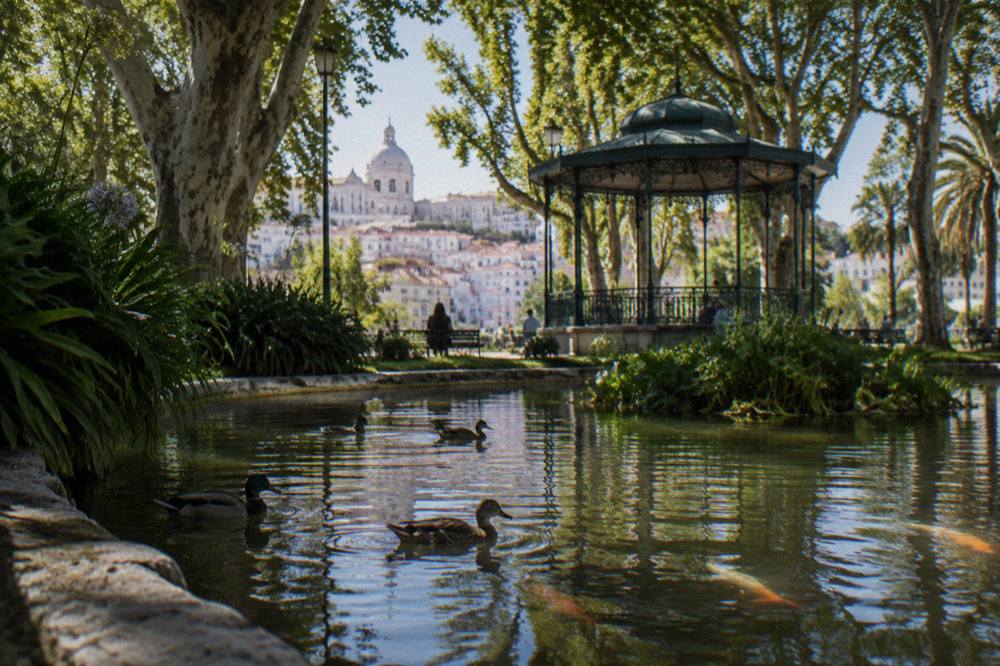
The Jardim da Estrela is the classic family garden. It covers 4.6 hectares in the English romantic style, with lakes holding ducks and carp, a wrought-iron bandstand from 1884, and enough winding paths that a child can believe the garden is bigger than it is. It is a free public garden, open to anyone, and it sits right beside the Basílica da Estrela, so the visit combines a garden, a square and a church exterior in one stop.
The Gulbenkian garden is the calmer choice, and it has the most reliable hours of any green space in the city: open every day from sunrise to sunset, free, with no closures to work around. The museum beside it is ticketed outside its Sunday-from-14:00 window, but under-18s are free, which makes it one of the few indoor options where the children's tickets are simply not a question. The garden itself, with its streams and shaded lawns, is the free part, and the official opening-hours page states the daily sunrise-to-sunset rule.
The Parque Eduardo VII is the biggest central park, free to enter, with a central grass axis, lakes and a playground. The Estufa Fria greenhouse inside the park is the exception to remember: it is ticketed, at EUR 3.70 standard, though free for under-6s and free for everyone on Sundays and public holidays until 14:00, with no residency condition printed. A family that treats the park as the destination and the greenhouse as an optional extra has the arithmetic right.
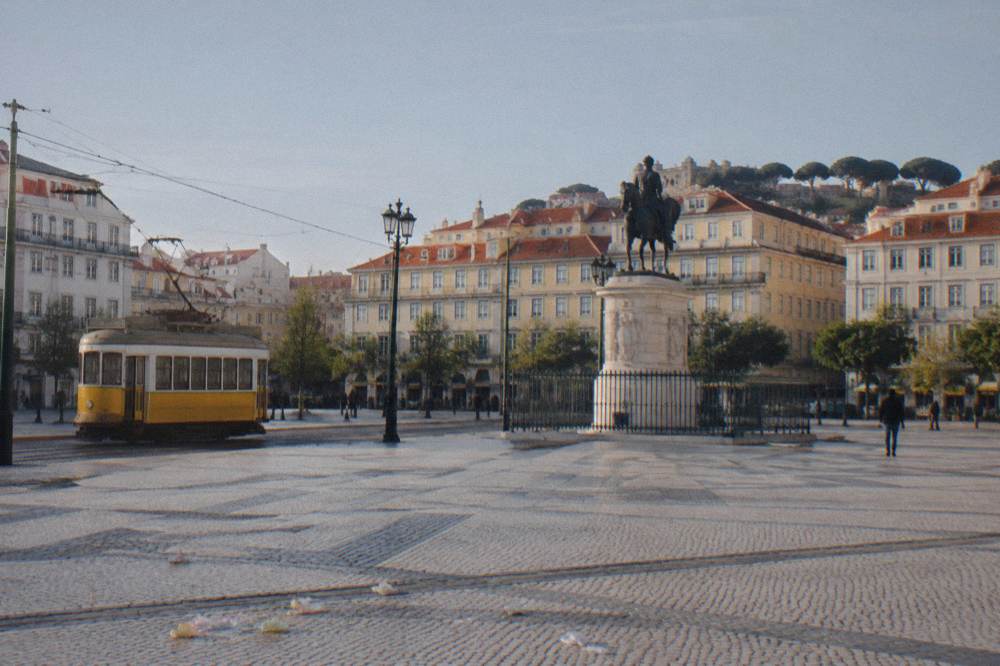
For open squares, the Praça do Comércio is hard to beat: a vast car-free riverside square where the worst that can happen is a pigeon chase. The Ribeira das Naus promenade beside the Tagus, with its broad steps and kiosk, links the square's Cais das Colunas towards Cais do Sodré and is free public space throughout. In Belém, the riverside and the Padrão square with its giant marble Compass Rose are free exteriors, while the Padrão's viewpoint and exhibition are ticketed.
| Place | What is free | What is paid |
|---|---|---|
| Jardim da Estrela | The whole garden, daily | Nothing on site |
| Gulbenkian garden | Garden, sunrise to sunset daily | Museum, except Sundays from 14:00 and under-18s |
| Parque Eduardo VII | The park and playground | Estufa Fria, EUR 3.70, free under 6 and Sunday mornings |
| Praça do Comércio and Ribeira das Naus | Square, steps and promenade | Nothing |
| Padrão square and Compass Rose, Belém | Square and Compass Rose | Viewpoint and exhibition, EUR 10 |
| Belém riverside | The whole waterfront walk | Belém Tower interior, EUR 15, free under 13 |
For a deeper run through the green spaces, the Lisbon parks and gardens guide covers the full list with each entry rule. Families based near Chiado should also know that the Essential History, Free Tastings walk by Tours Of My Life meets at Praça Luís de Camões, so a garden morning and a free walk can share a day without crossing the city.
Which Free Viewpoints Are Easy With A Pram?
The easiest free viewpoints with a pram are the Miradouro de São Pedro de Alcântara, a garden terrace with an azulejo map of the skyline, and the Parque Eduardo VII upper viewpoint, both reachable without stairs. The Miradouro da Graça is listed open 24 hours, and the Miradouro de Santa Catarina terrace takes in the Tagus estuary and the bridge. All are public spaces with no admission.
Viewpoints are Lisbon's free playground equipment, and each has a different character. The Miradouro de São Pedro de Alcântara in Bairro Alto has a formal garden, a kiosk and a large tiled map of the city laid out as an azulejo panel, which children treat as a where-are-we puzzle. The Miradouro de Santa Catarina, also called Adamastor, is a stone terrace with a small garden where the view takes in the Tagus estuary and the 25 April bridge, and where Visit Lisboa describes evenings with music, company and a drink as the sun goes down; the official page describes the terrace and its statue.
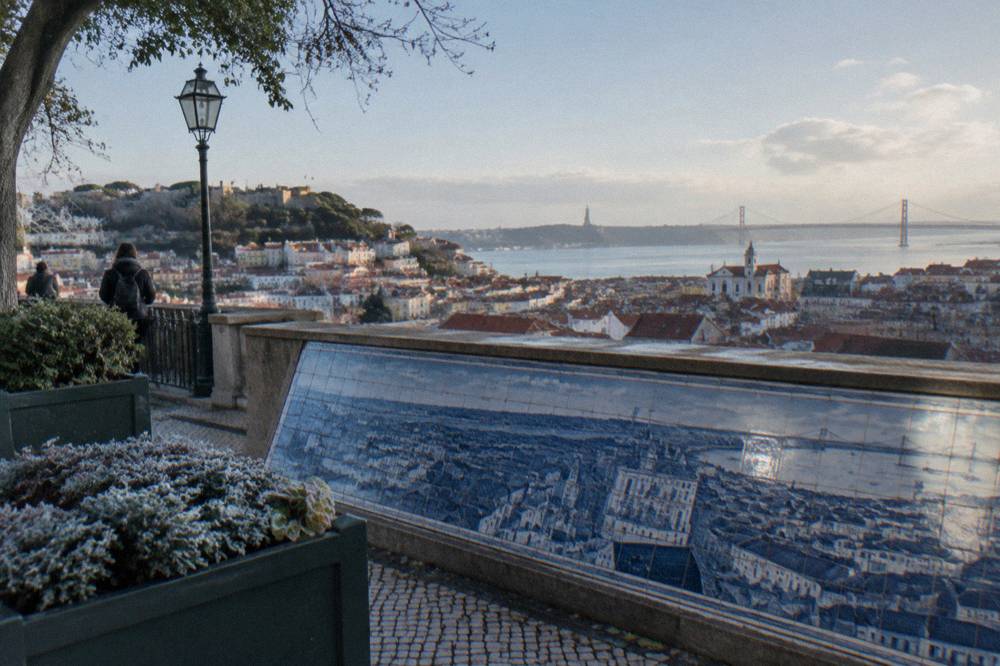
On the Graça hill, the Miradouro da Graça, officially named for Sophia de Mello Breyner Andresen, is listed on lisboa.pt as open 24 hours, and the Miradouro da Senhora do Monte is the panoramic one that faces the castle. The Miradouro de Monte Agudo has a pergola and a kiosk, and the Jardim do Torel is a quiet free garden viewpoint that most visitors never find. None of them charges admission, because all of them are simply streets and gardens with a view attached.
The pram question is really a hills question, and the honest answer involves the lifts. The Santa Justa lift and the Gloria, Bica and Lavra funiculars are all out of service, with no reopening date, so they cannot be part of any family plan. The one working exception is the Graça funicular, which reopened on 30 April 2026 and runs daily from 07:00 to 21:00, at EUR 4.30 onboard for two trips, so it is a paid shortcut up the Mouraria-to-Graça slope rather than a free ride. There are also free public elevators on the Baixa-Castelo route described by the city, though their current hours are not published, so check on the day.
The simplest pram route is to skip the lifts entirely and walk the Ribeira das Naus promenade, which is flat, riverside and free from end to end, then take a taxi or the metro up to a viewpoint rather than pushing uphill. Sunset here runs late in summer and around 17:15 in December, so an evening viewpoint stop with children is a summer luxury more than a winter one.
Which Free Walks Welcome Families?
Every walking tour on this site is free, pay what you want, so children join at no fixed price and the family decides the value at the end. The featured walk is Essential History, Free Tastings by Tours Of My Life, 3 hours in English and Spanish, rated 4.96 out of 5 across 25,140 GuruWalk reviews, meeting at Praça Luís de Camões.
A free walking tour is one of the few structured activities where a family's cost is decided after the fact rather than before it. Booking is free, the children take a place like anyone else, and each person gives the guide what they consider the walk was worth at the end. There is no child tariff to calculate in advance, which removes the usual per-head multiplication that makes guided activities expensive for families. The wider set of guides lives on Free Things To Do In Lisbon.
Essential History, Free Tastings is the walk with the deepest review pool on the whole roster: 4.96 out of 5 across 25,140 GuruWalk reviews, run by Tours Of My Life, 3 hours long, in English and Spanish, meeting at Praça Luís de Camões at the top of Chiado. It is the walk this article features, and you can See this free tour on its GuruWalk page. Three hours is a real commitment with young children, so treat it as the day's main event rather than one stop among several.
The shorter option is the SANDEMANs Original Walk, listed on freetour.com: 2 hours, in English and Spanish, meeting at Praça do Comércio, rated 9.4 out of 10 across 14,048 freetour.com reviews. Note the scale difference, that is a score out of ten on freetour.com, not out of five on GuruWalk, and the two are never converted. A two-hour walk from a flat riverside square is a much easier shape for a family with a toddler than a three-hour hill route.
For a self-guided alternative, the can I take a self-guided walk in Lisbon post covers the same ground at your own pace, and the free walking tours in Lisbon guide explains the full roster. The one thing no article can honestly promise is a route: no walk's listing publishes a verified stop list, so the meeting point, the district and the duration are the facts you can plan around.
What Does A Rainy Day Look Like With Children?
The best free rainy-day stop is the Museu do Dinheiro, which is free for everyone, open Wednesday to Sunday 10:00 to 18:00 with last admission at 17:30. After that, the options are windows rather than all-day free entry: the Gulbenkian museum is free on Sundays from 14:00 with under-18s free always, and MUHNAC is free on Sunday mornings from 10:00 to 13:00. The Gulbenkian garden stays free in any weather.
Rain in Lisbon is concentrated in a few months: the wettest by the 1991-2020 normals are November at 133.9 mm, October at 110.6 mm and December at 108.5 mm. A rainy-day plan therefore matters mostly from late autumn to early winter, and the free indoor list is shorter than parents hope.
The Museu do Dinheiro, in the former church of São Julião near Praça do Comércio, is the standout: free admission, no conditions, Wednesday to Sunday. It is small enough to hold a child's attention and central enough to reach without a long wet walk. The full rainy day in Lisbon post covers the rest of the list, including the free-entry windows at the University of Lisbon museums and the Museu do Oriente's Friday evening slot.
| Rainy-day stop | Free terms | Days open |
|---|---|---|
| Museu do Dinheiro | Free for everyone | Wednesday to Sunday, 10:00 to 18:00 |
| Gulbenkian museum | Free Sundays from 14:00, under-18s free | Wednesday to Monday; garden daily, sunrise to sunset |
| MUHNAC natural history museum | Free Sundays 10:00 to 13:00 | Tuesday to Sunday |
| Gulbenkian garden | Free daily, sunrise to sunset | Daily |
| Museu do Oriente | Free Fridays 18:00 to 20:00 | Tuesday to Sunday |
Two cautions keep the plan honest. The Tile Museum and the National Museum of Ancient Art are closed for works with no reopening date, so they cannot be rainy-day backups. And the residents-only Sunday windows at the municipal museums do not apply to visitors, so a family should not build a Sunday around them.
Fado deserves a mention as the indoor cultural option that costs only drinks: fado vadio, the amateur, spontaneous kind, is sung in small eateries around the square beside the church of São Miguel in Alfama, and the Museu do Fado's roteiro names Tasca do Chico in Bairro Alto for fado on Monday and Wednesday nights. Children are welcome in tascas in a way they rarely are in concert venues, and the cost is whatever the family eats and drinks. Fado itself was inscribed by UNESCO on its intangible heritage list in 2011, which is a nice fact for a child who asks why the adults have gone quiet.
Which Costs Catch Families Out?
The costs that surprise parents are the tourist tax, EUR 4 per night per guest aged 13 and over, so younger children are exempt, tram 28 at EUR 3.30 per person on board, and the big-ticket monuments: EUR 18 for the Jerónimos cloister, EUR 15 for Belém Tower and EUR 17 for São Jorge Castle, all free for under-13s.
The tourist tax is the one almost nobody sees coming. Lisbon charges EUR 4 per night per guest aged 13 or over, up to a maximum of 7 nights per person per stay, raised from EUR 2 in September 2024. A family with two children under 13 pays for the adults only, which softens it, but it is paid at the accommodation and it is not optional.
Tram 28 is the classic family ride and it is not free: EUR 3.30 bought on board, or EUR 1.72 with Zapping, and the official Carris price table is the source for both. Children pay the same onboard fare, there is no free-child rule on the tram. The ride is famous for a reason, but a family of four pays over EUR 13 for it, and the free alternative is walking the same streets.
| Item | Adult cost | Child rule |
|---|---|---|
| Tourist tax | EUR 4 per night | Free under 13, max 7 nights |
| Tram 28 | EUR 3.30 onboard | Same onboard fare, no child discount |
| Jerónimos Monastery cloister | EUR 18 | Free under 13, 50% for ages 13 to 24 |
| Belém Tower | EUR 15 | Free under 13 |
| São Jorge Castle | EUR 17 | Free under 13; Lisboa Card adults free |
| Sé de Lisboa tourist visit | EUR 7 | Prayer space free, visit ticketed |
| Museu do Fado | EUR 5 | Free up to 12 |
| Carmo Convent ruins | EUR 7 | Free for 0 to 14 with an adult |
| Estufa Fria | EUR 3.70 | Free under 6, free Sundays until 14:00 |
| Graça funicular | EUR 4.30 for 2 trips | Paid for all, Navegante accepted |
The monuments need the most careful wording, because the free days that circulate online are for residents in Portugal, not visitors. The Jerónimos cloister at EUR 18 and Belém Tower at EUR 15, both run by Museus e Monumentos de Portugal, are paid for visitors every day of the week; the 52 free days a year under the Acesso 52 scheme require a Portuguese Citizen Card. What families do get is the child tier: under-13s are free at both, and ages 13 to 24 pay 50% at the Jerónimos. The Belém guide covers the district's free exteriors in full.
The Sé de Lisboa is the subtlest one. The space reserved for prayer is free, but the tourist visit to the naves, treasury and choir is ticketed at EUR 7, and visits are limited during worship. A family that walks in expecting a free cathedral gets a ticket desk, so know which of the two you are doing. And the closed lifts and funiculars catch out anyone with an old guidebook: the Santa Justa lift, the viewpoint above it, and the Gloria, Bica and Lavra funiculars are all out of service, so a plan that counts on them collapses on arrival.
Common Questions On This Topic
What Can Children Do For Free In Lisbon?
Children can roam the free public gardens like the Jardim da Estrela and the Gulbenkian garden, the miradouro viewpoints, the Praça do Comércio and the Belém riverside, and the free-entry Museu do Dinheiro, all at no cost. Free, pay what you want walking tours take children along at no fixed price, and under-13s enter the Jerónimos cloister, Belém Tower and MAAT free.
Are Lisbon's Museums Free For Children?
Several are. Under-13s are free at the Jerónimos Monastery cloister, Belém Tower and MAAT, under-12s are free at the Museu do Fado, under-6s are free at the Estufa Fria, and under-18s are free at the Gulbenkian museum. The Museu do Dinheiro is free for everyone, adults included, Wednesday to Sunday.
Is Tram 28 Free For Kids?
No. Tram 28 costs EUR 3.30 per person bought on board, or EUR 1.72 with Zapping, and there is no free-child fare. The Lisboa Card covers trams, so families planning several rides and paid sights should compare the card's EUR 31 adult 24-hour price against their itinerary.
Which Lisbon Gardens Are Free?
The Jardim da Estrela, the Gulbenkian garden, the Parque Eduardo VII and the Jardim do Torel are all free public green spaces. The two botanical gardens are not free outside their Sunday 10:00 to 13:00 window, and the Jardim Botânico Tropical charges EUR 8 for adults.
Do Children Pay The Lisbon Tourist Tax?
No, guests under 13 are exempt. The tax is EUR 4 per night per guest aged 13 or over, capped at 7 nights per person per stay, and it rose from EUR 2 in September 2024. It is charged through the accommodation, not at attractions.
Are Free Walking Tours Suitable For Children?
Every walk on this site is free, pay what you want, so children take a place at no fixed cost and the family tips what the walk was worth. The Essential History, Free Tastings walk runs 3 hours, which suits older children, while the 2-hour SANDEMANs Original Walk on freetour.com is a shorter shape for younger ones.
The last word belongs to the closing trio of walks, all free, pay what you want, all run by independent local guides on GuruWalk: Old Neighborhoods And Stories, 2 hours 45 in English, Spanish and French; Local Perspective, 2 hours 15 in English from Praça Luís de Camões; and Unmissable Alfama by Hi Lisbon Walking Tours, 2 hours 30 in English from Praça do Comércio, rated 4.78 out of 5 across 1,706 GuruWalk reviews. Whichever shape a family picks, the price of the walk itself is the one line item that stays under its own control.