Lisbon Neighbourhoods: A Free Walking Guide To Every District
Lisbon splits into a handful of walkable districts, each with a different free side: hilltop viewpoints in Alfama and Graca, grand squares in Baixa, fado nights in Bairro Alto and a riverside promenade in Belem. Here is what costs nothing in each one, and what does not.
Short answer
Alfama, Mouraria and Graca give you free miradouros and fado vadio nights. Baixa and Chiado offer free squares, the Museu do Dinheiro and the Rua Augusta arch passage. Bairro Alto adds free fado tascas. Belem's riverside and gardens are free, while the Tower (EUR 15) and Jeronimos cloister (EUR 18) are ticketed. Free walking tours run in every district.
Lisbon is a city of separate little worlds stacked on adjoining hills. Alfama tangles itself into lanes below the castle, Baixa runs in a rigid grid down to the river, Chiado keeps the bookshops and cafes, Bairro Alto wakes at night, and Belem sits apart by the Tagus with the monuments of the Age of Discovery. Each district has a free side, and each has ticketed landmarks that catch visitors out. This guide walks through them one by one, naming what costs nothing, what carries a condition, and where the free pay what you want walking tours meet.
The honest summary up front: the viewpoints, squares, riverside walks, public gardens and street life are free. The towers, castle, cloisters and most museums are not. The 63 free walking tours listed across GuruWalk and freetour.com run in every central district, and they cost nothing to reserve, pay what you want at the end.
Which Lisbon Neighbourhoods Are Best To Walk?
The best districts to walk are Alfama and Graca for lanes and viewpoints, Baixa and Chiado for grand squares and flat strolling, Mouraria for street life and fado history, Bairro Alto for nightlife, and Belem for riverside monuments. All five are walkable without a ticket, though the hills between them are steep and the funiculars are mostly out of service.
Alfama is the oldest surviving district, the part of the city that came through the 1755 earthquake with its medieval street pattern intact. That makes it the most rewarding place to walk with no plan and no ticket: the lanes climb from the river toward the castle, and the miradouros open up over the rooftops at intervals. Chiado and Baixa are the opposite experience, rebuilt after the earthquake on a rational grid, so the walking is easy and the architecture belongs to the Pombaline rebuilding rather than the middle ages.
Bairro Alto sits above Baixa and changes character by the hour, quiet in the morning and crowded at night. Mouraria, beside it toward Martim Moniz, is where fado is said to have been born and where the streets still carry that history. Belem is the outlier, west of the centre by the river, and it rewards a longer visit with gardens, a riverside promenade and the biggest concentration of ticketed monuments in the city.
| Neighbourhood | Character | Free highlights | Paid landmarks |
|---|---|---|---|
| Alfama | Medieval lanes, hillside | Miradouro de Santa Luzia, Portas do Sol, the lanes themselves | Sao Jorge Castle EUR 17, the cathedral visit EUR 7 |
| Mouraria | Fado birthplace, street life | Lanes, squares, fado history | Sao Vicente de Fora EUR 8 |
| Graca | Viewpoint hill, village feel | Miradouro da Graca (open 24 hours), Senhora do Monte | Graca funicular EUR 4.30 for two trips |
| Baixa | Rebuilt grid, grand squares | Praca do Comercio, the Rua Augusta arch passage, Museu do Dinheiro | Rua Augusta arch viewpoint (paid, price not published) |
| Chiado | Bookshops, cafes, theatres | Largo do Carmo, Rua Garrett, Santa Catarina viewpoint | Carmo Convent ruins EUR 7 |
| Bairro Alto | Nightlife district | Miradouro de Sao Pedro de Alcantara, fado vadio nights | Drinks, and the door policy at each tasca |
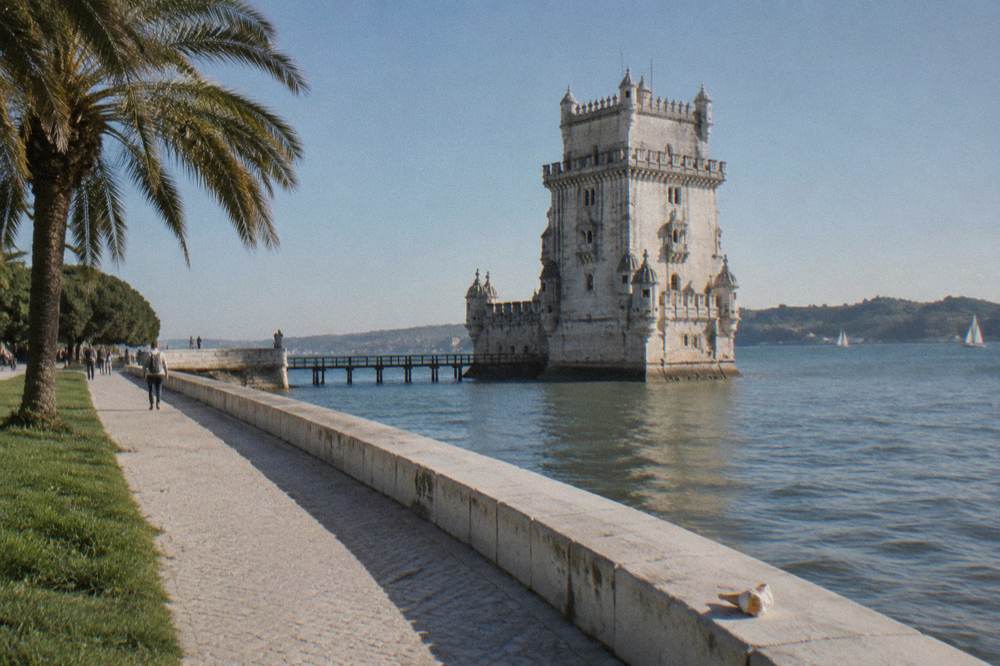
| Belem | Monumental riverside | Riverside promenade, Praca do Imperio gardens, MAAT gardens | Belem Tower EUR 15, Jeronimos cloister EUR 18, MAAT EUR 16 |
For a deeper route through the oldest district, see the Alfama free walking guide, and for the viewpoints themselves start with the miradouros in Lisbon guide. This site, Free Things To Do In Lisbon, covers each district in its own page, so this one stays at the level of choosing between them.
What Is Free In Alfama, Mouraria And Graca?
The free side of these eastern hills is the viewpoints, the lanes and the fado vadio nights: Miradouro de Santa Luzia, Portas do Sol, the Graca viewpoint (open 24 hours) and Senhora do Monte all cost nothing. The castle on the hill above Alfama is ticketed at EUR 17, the cathedral visit is EUR 7, and only the cathedral's prayer space is free.
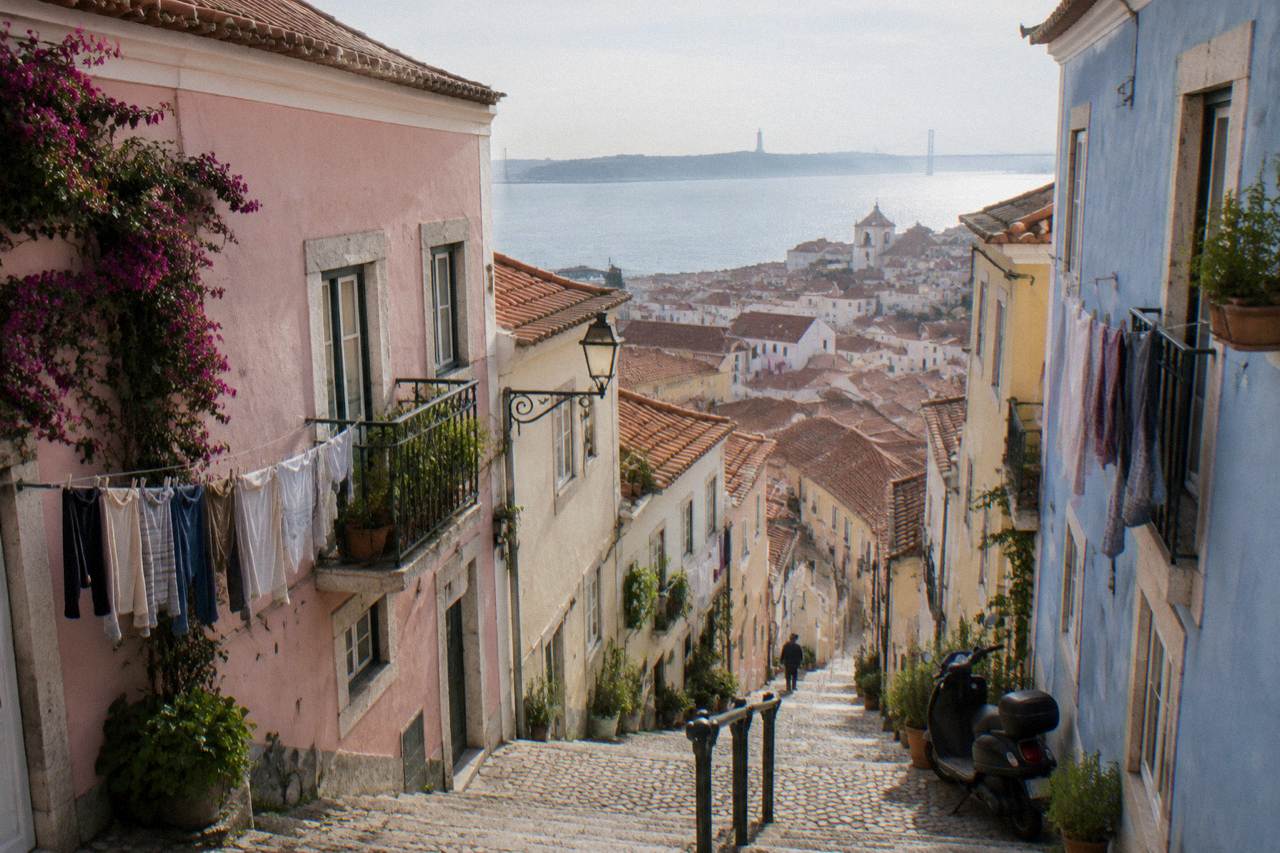
Alfama's viewpoints are the reason most people climb the hill. Miradouro de Santa Luzia has a garden, a pond, azulejo panels and a kiosk, and it is a free public space. Miradouro das Portas do Sol sits a lane away with another free terrace and its own kiosk. Higher up, in Graca, the Miradouro da Graca, officially named for the poet Sophia de Mello Breyner Andresen, is listed on lisboa.pt as open 24 hours, and Miradouro da Senhora do Monte is the panoramic one people climb to at sunset. None of them charges, and none of them is more than a walk apart.
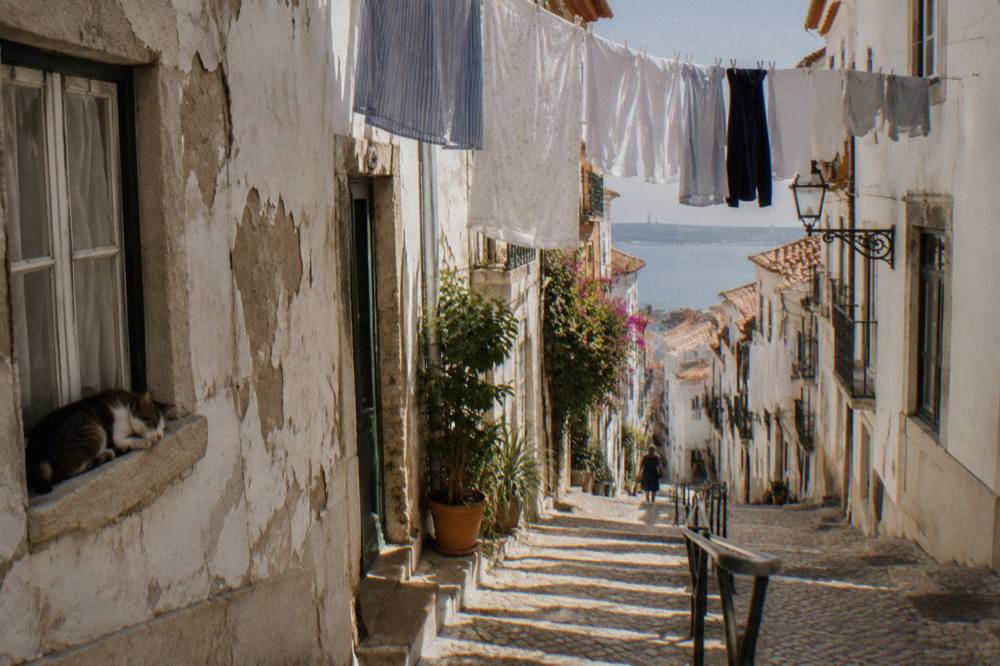
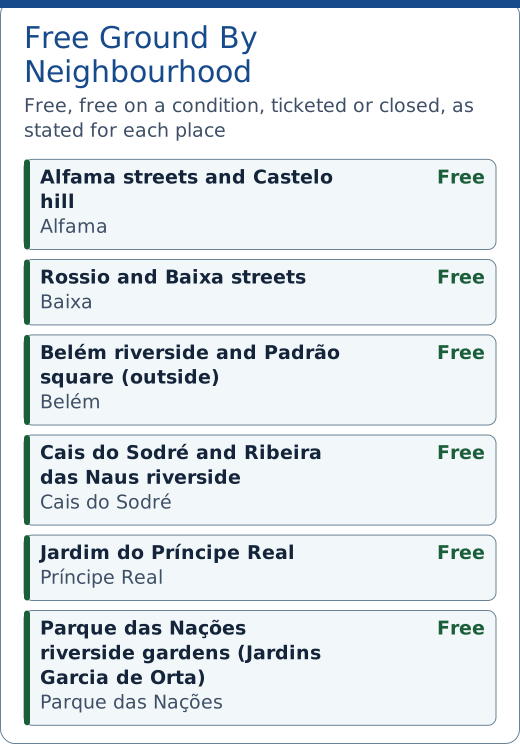
The lanes between them cost nothing either, and they are the real attraction: Alfama is the only central district that kept its medieval street pattern, so every descent toward the river is a different route. The two facts to hold onto about the hill are these. The Castelo hill and the Alfama streets are free to walk, while Sao Jorge Castle itself is ticketed at EUR 17. And the Se de Lisboa, the cathedral at the bottom of the hill, keeps a separate space reserved for prayer that is free, while the tourist visit to the naves, treasury and choir is EUR 7. A tower or interior never inherits the status of the hill it stands on. This stop sits on a free walking route, Take's Alfama Old Town.
Mouraria, west of Alfama toward Martim Moniz, is the district where fado is said to have been born, and it is free to wander in the same way. The Museu do Fado, which sits at its edge near Santa Apolonia, is ticketed at EUR 5 for visitors from outside the Lisbon municipality, so treat it as a paid stop rather than a free one. For the full fado picture, including where amateur fado vadio actually runs, see the free fado in Lisbon guide.
One practical note for these hills: the Graca funicular, which runs from Mouraria up to Graca, reopened on 30 April 2026 after safety certification and runs daily, but it is a paid ride at EUR 4.30 for two trips, with a Navegante pass accepted. The other funiculars are a different story, covered below. The hills themselves are free to walk, and the Mouraria and Graca guide maps them out.
What Is Free In Baixa, Chiado And Bairro Alto?
Baixa gives you the Praca do Comercio, the Rua Augusta arch passage and the free Museu do Dinheiro, all in a flat grid. Chiado adds the Largo do Carmo and the Santa Catarina viewpoint, and Bairro Alto adds the Sao Pedro de Alcantara viewpoint and fado vadio nights. The Carmo Convent ruins are paid at EUR 7, and the arch's upper viewpoint is a separate paid attraction.
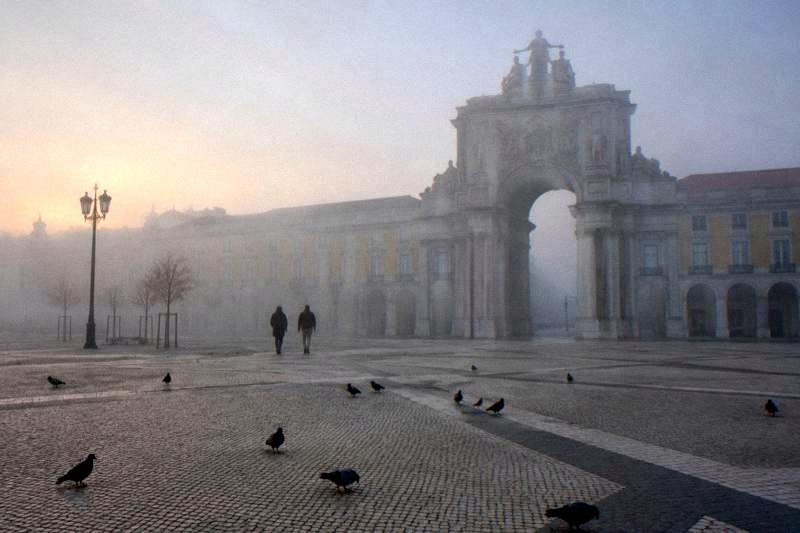
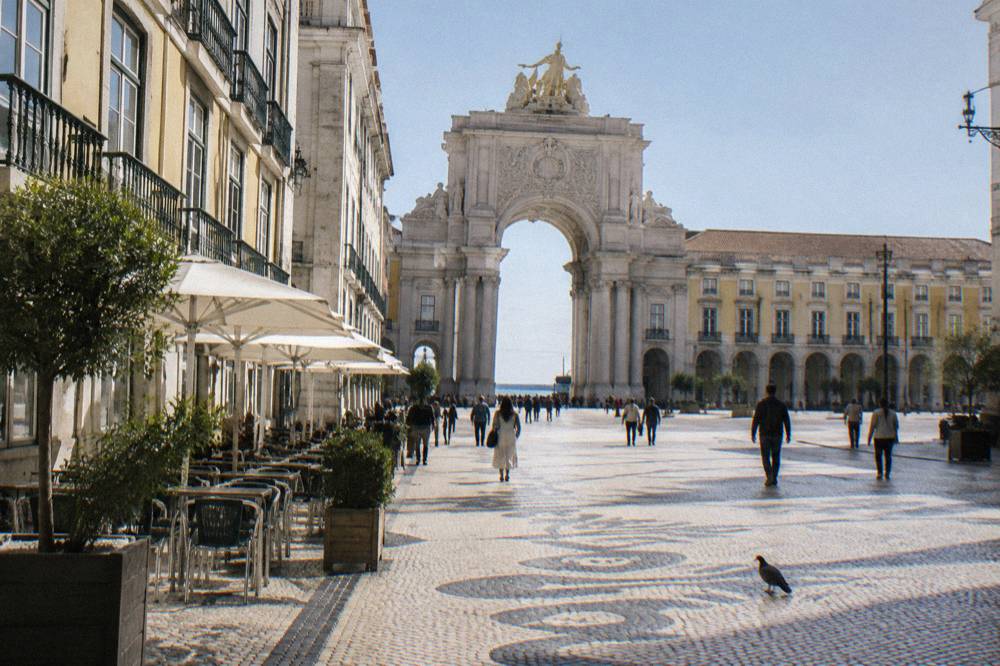
Baixa is the district rebuilt after the 1755 earthquake, and its geometry is the free attraction: a rational grid of streets running down to the Praca do Comercio, the grand square on the site of the destroyed royal palace. The square is a free public space, and walking through the Rua Augusta Arch at its corner is free too. The arch's upper viewing platform is a separate paid attraction, free only with a Lisboa Card, and the adult price is not published on the official page, so treat the arch as a free passage with a paid platform above it.
The Museu do Dinheiro, the Banco de Portugal's money museum in the former church of Sao Juliao, is one of the few genuinely free museums in the city, open Wednesday to Sunday with no ticket at all. It sits a street back from the square, which makes it the obvious free stop in Baixa. For the wider picture of which museums are free and under what conditions, see the free museums in Lisbon guide.
Chiado climbs west of Baixa, and its free side is the street life: Rua Garrett with the Bertrand bookshop, the Largo do Carmo, and the terrace at the top of the Santa Catarina viewpoint, where the Visit Lisboa description promises sunset with music, the Tagus estuary and the bridge in view. The Carmo Convent ruins beside the Largo do Carmo are the paid counterpart, EUR 7 for adults, with no free day listed, and they are the most direct 1755 earthquake relic in the district.
Bairro Alto, above Chiado, is quiet by day and packed at night. Its free landmarks are the Miradouro de Sao Pedro de Alcantara, a garden viewpoint with an azulejo map of the skyline, and the fado vadio tradition in the tascas: amateur fado sung on set nights, where the cost is what you drink. Tasca do Chico on Rua do Diario de Noticias runs fado vadio on Monday and Wednesday nights, though the door policy on cover or minimum consumption is not stated anywhere official, so confirm at the door. For the full picture of the 1755 earthquake that shaped this whole district, see the Lisbon 1755 earthquake guide.
Two pay what you want walks meet in this central belt. The Essential History, Free Tastings walk by Tours Of My Life, rated 4.96 out of 5 across 25,140 GuruWalk reviews, meets at Praca Luis de Camoes on the Chiado side and runs three hours in English or Spanish, and it is the walk to pick if one walk has to cover the central neighbourhoods. You can see the Essential History free tour for its meeting point and schedule.
SANDEMANs Original Walk, listed on freetour.com, is the other central option: two hours in English or Spanish, rated 9.4 out of 10 across 14,048 freetour.com reviews, meeting at the Praca do Comercio, which puts the whole Baixa grid at its doorstep.
Between them, these two walks bracket the central belt from both ends, one starting on the Chiado hill and one from the riverside square, so the choice between them usually comes down to where your day begins rather than to any difference in what they cover. Both are free to reserve and pay what you want at the end, and both run in English, with the Essential History walk adding Spanish and the SANDEMANs walk offering both.
What Is Free In Belem And Alcantara?
Belem's free side is the riverside promenade, the Praca do Imperio gardens and the public gardens around the Centro Cultural de Belem, plus the Padrao's exterior terrace and Compass Rose. The Tower is EUR 15, the Jeronimos cloister is EUR 18, the Padrao viewpoint is EUR 10 and MAAT is EUR 16 for non residents. Alcantara's LX Factory complex can be walked through freely, with its Sunday market running 11:00 to 18:00.
Belem is the district where the free and paid sides sit closest together. The riverside promenade along the Tagus is a free public walk, and the gardens behind it, including the Praca do Imperio gardens and the public gardens and esplanade of the Centro Cultural de Belem, are open public space. The MAAT's riverside gardens outside the museum are public too, even though the museum itself is ticketed, EUR 16 for non residents, with a free first Sunday morning that applies to residents in Portugal only.
The monuments need the two facts treatment. The Padrão dos Descobrimentos has a free exterior: the access terrace and the Compass Rose in the paving can be walked on at no cost, while the viewpoint on top and the exhibition are ticketed, the viewpoint at EUR 10. The Belem Tower's exterior is free to see from the riverside, while the interior is ticketed at EUR 15, and the tower reopened in May 2026 after restoration with timed entry. The Jeronimos Monastery's cloister is EUR 18 for visitors, and there is no free Sunday for tourists at any of these national monuments: the 52 free days a year under the Acesso 52 scheme are for residents in Portugal only, with a Citizen Card. Children up to 12 are free.
Alcantara, between Belem and the centre, holds the LX Factory, a former industrial complex turned into shops, restaurants and studios on Rua Rodrigues de Faria. You can walk the complex freely and pay only at the shops and restaurants. Its Sunday market, the LX Market, runs Sundays from 11:00 to 18:00 with handmade and vintage stalls. Tram 15E and buses 714 and 727 serve the district, and the tram continues to Belem, stopping at Mosteiro dos Jeronimos and the CCB. For the full district guide see Belem and the Age of Discovery, and for the creative complex itself the LX Factory guide.
How Steep Are The Hills Between Neighbourhoods?
Most of Lisbon sits below 100 metres, but the district cores sit on separate hills, and the climbs between them are real: the city's highest point is 230 metres at the Monsanto ridge. The calcada paving becomes slippery on slopes. Of the historic lifts, only the Graca funicular is running, at EUR 4.30 for two trips, while Santa Justa and the Gloria, Bica and Lavra funiculars are out of service.
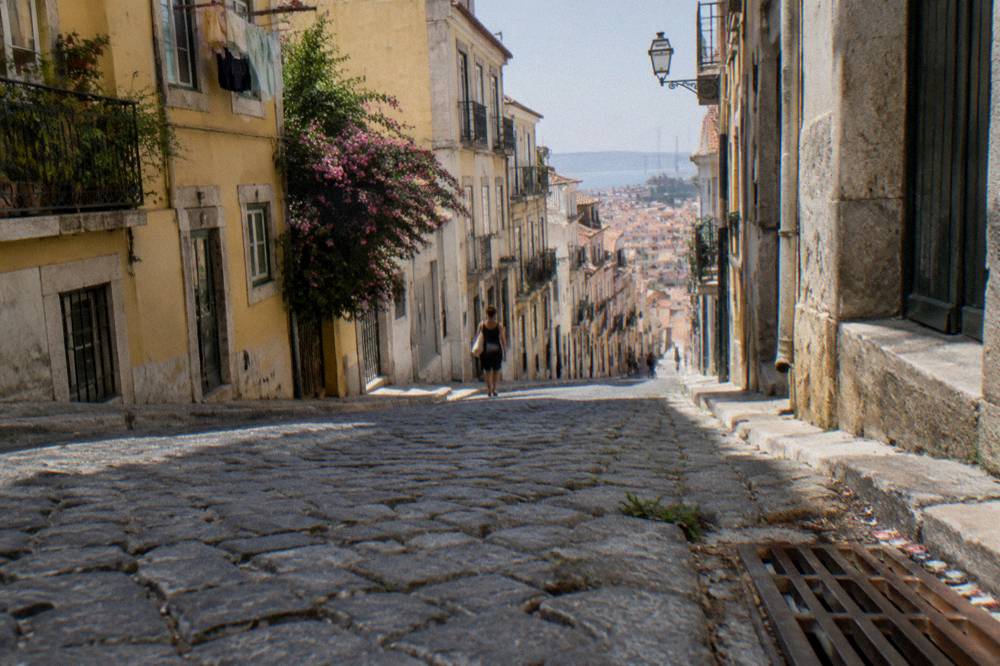
The geography is gentler than the reputation. Lisbon is mostly a low city, and the hills that matter to a walker are the Castelo, Graca and Senhora do Monte ridges, plus the Bairro Alto plateau. What makes them tiring is not the height but the paving: the calcada portuguesa of white limestone and black basalt cubes, laid by hand, becomes polished and slippery with use, especially on slopes, so the descents deserve as much attention as the climbs.
The mechanical help is thin on the ground. Carris marks the Santa Justa lift and its viewpoint closed, and the Gloria, Bica and Lavra funiculars are all out of service, with substitute buses 51E, 22B and 19B covering their routes. The exception is the Graca funicular, which reopened on 30 April 2026 and runs daily from 07:00 to 21:00, at EUR 4.30 onboard for two trips, with a Navegante pass accepted. It is a paid ride, not a free one.
There are free public lifts on the Baixa to Castelo route, described by the city as municipal elevators on the Rua dos Fanqueiros and Rua da Madalena axis and the Chao do Loureiro side, but their current hours and operating status are not published on a current official page, so check on the day. Tram 28 climbs the Alfama hill, but it is a paid ride at EUR 3.30 onboard, or EUR 1.72 with Zapping. The free way up every hill in this city is your own feet, and the is Lisbon walkable blog post covers the gradients in detail.
| Route between districts | On foot | Mechanical option | Cost |
|---|---|---|---|
| Baixa to Alfama / Castelo | Steep climb on lanes | Free public lifts (status unconfirmed), tram 28 | Tram EUR 3.30 onboard |
| Baixa to Chiado | Short climb | None needed | Free on foot |
| Chiado to Bairro Alto | Moderate climb | Gloria funicular out of service | Free on foot only |
| Mouraria to Graca | Steep climb | Graca funicular, running daily | EUR 4.30 for two trips |
| Baixa to Santa Catarina | Moderate climb | None | Free on foot |
Which Neighbourhood Suits A First Free Day?
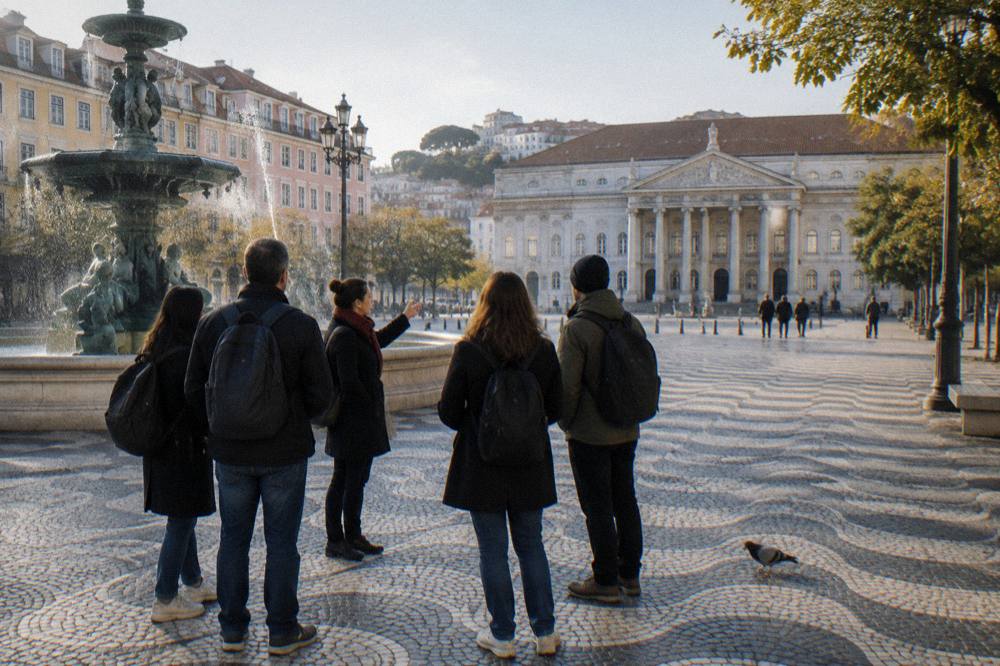
For a first day, walk Baixa and the Praca do Comercio in the morning, climb into Alfama's viewpoints after lunch, and end at Santa Catarina or the Graca viewpoint for sunset. Every stop on that route is free. If you want a guide from the start, the pay what you want walks meeting at Restauradores, Rossio and the Praca do Comercio put the same route in a single walk.
The logic is the geography. Baixa is flat, so it absorbs the jet lag; the Praca do Comercio, the arch passage and the Museu do Dinheiro sit within a few minutes of each other and cost nothing. Alfama rewards the afternoon, when the lanes are warm and the viewpoints are working with the light, and the climb is easier after a meal than before one. Sunset belongs on a western terrace: Santa Catarina faces the river and the bridge, and the Graca viewpoint, open 24 hours, gives the wide city panorama.
A first day does not need Belem, which sits apart by the river and deserves its own half day with the gardens, the promenade and a decision about which monument interiors are worth their tickets. It does not need the castle interior either: the castle terrace costs EUR 17, while the free walking of the hill around it delivers most of the same views. If the budget question is the whole trip rather than one day, the Lisbon on a budget guide does the arithmetic, and the top 5 free things to do blog post is the short list version.
If a guided walk fits the first day better than finding the route alone, the Unmissable Essentials By Take walk, rated 4.87 out of 5 across 6,312 GuruWalk reviews, meets at the Praca dos Restauradores and runs 2 hours 45 minutes in English, Spanish, French and Italian, the widest language offer among the central walks.
Which Free Walking Tours Cover Which Neighbourhood?
Every central district has pay what you want walks: the Essential History walk meets at Praca Luis de Camoes for the central belt, the Alfama walks meet at the Praca do Comercio, Praça da Figueira and Rossio, and the Belem walks meet in the Jardim Afonso de Albuquerque. All 63 walks listed on this site run on GuruWalk or freetour.com, all are free to reserve, and none of the featured ones carries a required cost.
The roster on this site spans 63 free walking tours across GuruWalk and freetour.com. The central belt has the deepest coverage: walks meet at the Praca do Comercio, Praca Luis de Camoes, Rossio and the Praca dos Restauradores, and they run in English, Spanish, French, Italian and German depending on the walk. Alfama has its own cluster, meeting at the Praca do Comercio, Rua dos Bacalhoeiros, Rossio and the Praça da Figueira. Belem's walks meet in the Jardim Afonso de Albuquerque or on Rua de Belem, and the miradouros walks start at Praca Luis de Camoes or the Miradouro de Sao Pedro de Alcantara.
| Neighbourhood | Walk (decision name) | Platform | Rating and reviews | Meets at |
|---|---|---|---|---|
| Central belt | Essential History, Free Tastings | GuruWalk | 4.96 out of 5 across 25,140 reviews | Praca Luis de Camoes |
| Central belt | SANDEMANs Original Walk | freetour.com | 9.4 out of 10 across 14,048 reviews | Praca do Comercio |
| Central belt | Unmissable Essentials By Take | GuruWalk | 4.87 out of 5 across 6,312 reviews | Praca dos Restauradores |
| Alfama | Alfama Secrets, Hi Lisbon | GuruWalk | 4.78 out of 5 across 1,706 reviews | Praca do Comercio |
| Alfama | Take's Alfama Old Town | GuruWalk | 4.85 out of 5 across 1,402 reviews | Rua dos Bacalhoeiros 12 |
| Viewpoints | Top 8 Miradouros Walk | GuruWalk | 5 out of 5 across 1,277 reviews | Praca Luis de Camoes |
| Belem | Age Of Discoveries, Belem | GuruWalk | 4.86 out of 5 across 1,593 reviews | Jardim Afonso de Albuquerque |
| Themed | Black History Walk | GuruWalk | 4.97 out of 5 across 287 reviews | Praca do Comercio |
The full walk by walk breakdown, including the Spanish, Italian and German language walks and the themed tours, is in the free walking tours in Lisbon guide. The question of what pay what you want actually means in practice, and what walkers typically give at the end, is covered in the are free walking tours really free blog post.
For the Alfama side of the choice, the Local Perspective walk, rated 4.86 out of 5 across 301 GuruWalk reviews, meets at Praca Luis de Camoes for 2 hours 15 in English, while the Alfama walks below start from the old town itself.
Common Questions About Lisbon Neighbourhoods
Which Lisbon Neighbourhoods Are Best To Walk?
Alfama and Graca for lanes and free viewpoints, Baixa and Chiado for flat squares and the free Museu do Dinheiro, Mouraria for fado history, Bairro Alto for nightlife, and Belem for riverside gardens. Every one of them is free to walk, though the eastern hills are steep and the funiculars, apart from the Graca line, are out of service.
Is Alfama Free To Visit?
The lanes, the miradouros and the whole hillside are free to walk. Sao Jorge Castle on the hill above is ticketed at EUR 17, and the Se de Lisboa's tourist visit is EUR 7, with only the prayer space free. The viewpoints, Santa Luzia, Portas do Sol and the Graca terrace, cost nothing.
Is Belem Free?
The riverside promenade, the Praca do Imperio gardens, the CCB's public gardens and the Padrão's exterior terrace with its Compass Rose are all free. The Belem Tower interior is EUR 15, the Jeronimos cloister is EUR 18 and the Padrão viewpoint is EUR 10, and none of the national monuments has a free Sunday for visitors.
Can You Walk Between Lisbon Neighbourhoods?
Yes, and walking is the free way to do it. Most of the city sits below 100 metres, but the climbs into Alfama, Graca and Bairro Alto are steep and the hand laid paving is slippery on slopes. Of the mechanical options, only the Graca funicular is running, at EUR 4.30 for two trips, and tram 28 is EUR 3.30 onboard.
Which Neighbourhood Is Best For A First Visit?
Baixa for the morning, because it is flat and its squares and the Museu do Dinheiro are free, then Alfama's viewpoints in the afternoon and a western terrace such as Santa Catarina for sunset. Belem deserves its own half day rather than a rushed add on.
Are The Free Walking Tours Really Free?
The 63 walks listed on this site are free, pay what you want, reserved on GuruWalk or freetour.com at no charge, with each walker paying the guide what they consider the walk worth at the end. No featured walk on this site declares a separate required cost or deposit.