Lisbon 1755 Earthquake: Free Places To See Its Story
On the morning of 1 November 1755, one of Europe's deadliest earthquakes destroyed most of central Lisbon. The city that was rebuilt on top of it, the Baixa grid, still tells the story, and much of that story can be read for free.
Short answer
The 1755 earthquake struck Lisbon on the morning of 1 November 1755, followed by a tsunami and fires that burned for about six days. The Baixa grid, Praça do Comércio and a free booked archaeological site show the story for free today; the Carmo Convent ruins are ticketed at EUR 7 with no free day.
On the morning of 1 November 1755, All Saints Day, Lisbon was shaken by one of the deadliest earthquakes in European history. Estimates of its magnitude range from about 7.7 to 8.7, and the shaking was only the beginning: tsunami waves of about six metres followed, and fires burned for roughly six days. Modern estimates of the dead in the city run from about 30,000 to 60,000, a range so wide because the disaster destroyed the records needed to count its own victims.
What makes the 1755 earthquake different from most historical catastrophes is how visible it still is. The rebuilding produced the Baixa grid, one of the earliest examples of earthquake-resistant urban planning in Europe, and its timber-framed "gaiola pombalina" construction is part of why the neighbourhood is on UNESCO's Tentative List. The ruined Carmo Convent was deliberately left open to the sky as a memorial. A free, booked archaeological site under the Baixa shows the Roman and Pombaline layers side by side. This guide walks through what happened, where the traces survive, what is free, what is ticketed, and which free walking tours tell the story.
What Happened In The 1755 Lisbon Earthquake?
The earthquake struck Lisbon at about 9:30 to 9:40 in the morning on 1 November 1755, All Saints Day, when churches were full for the holiday. Shaking was followed by tsunami waves of about six metres and fires that burned for about six days. Death estimates range from about 30,000 to 60,000 in the city, and magnitude estimates run from about 7.7 to 8.7.
The date mattered. All Saints Day meant candles were lit in churches across the city, and many people were inside when the shaking began. The fires that followed the initial shock burned for roughly six days, and the tsunami waves that reached Lisbon were about six metres high. Between the shaking, the water and the fire, most of central Lisbon was destroyed, including the royal palace on the waterfront.
The scale of the disaster is still debated. Britannica cites about 60,000 dead in Lisbon, while other estimates put the city's losses at 30,000 to 40,000 with up to 60,000 in total. The magnitude is similarly uncertain: a USGS historical page gives 8.7, while a peer-reviewed reassessment published in the Bulletin of the Seismological Society of America in 2020 gives 7.7 plus or minus 0.5. Honest accounts give the range rather than a single number.
The disaster reshaped the city politically as well as physically. The reconstruction was directed by the Marquis of Pombal, and his name is attached to both the rebuilt downtown, the Baixa Pombalina, and the statue that stands at the top of Avenida da Liberdade in Praça do Marquês de Pombal. The rebuilding also produced something genuinely new in construction: the gaiola pombalina, a timber cage frame built into the walls of the new downtown, an early attempt at earthquake-resistant building.
| What | The record |
|---|---|
| Date and time | 1 November 1755, about 9:30 to 9:40 in the morning, All Saints Day |
| Magnitude estimates | About 7.7 to 8.7, depending on the study |
| Tsunami | Waves of about six metres at Lisbon |
| Fires | Burned for about six days |
| Death toll | Estimates from about 30,000 to 60,000 |
The Baixa Pombalina reconstruction is on UNESCO's Tentative List, which cites the gaiola pombalina timber-framed construction as an early earthquake-resistant technique. For a fuller picture of how the rebuilding shaped the neighbourhood you walk through today, see the companion guide to Baixa and Rossio Square.
Where Can You See Earthquake Traces For Free?
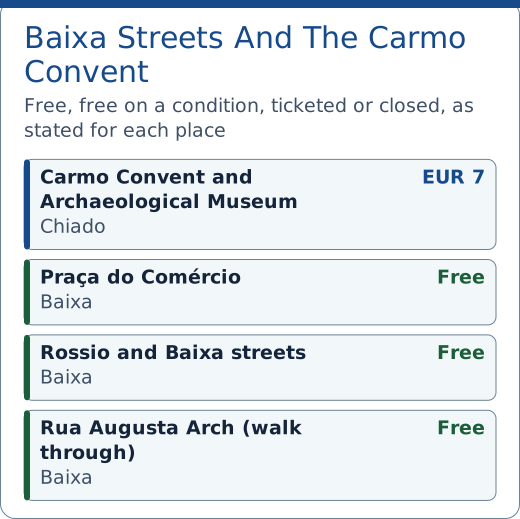
The free earthquake traces are the Baixa grid itself, Praça do Comércio, rebuilt from 1756 on the site of the destroyed royal palace, and the Núcleo Arqueológico da Rua dos Correeiros, a free guided archaeological visit booked in advance. The Carmo Convent ruins, the most famous trace of all, are ticketed, and the Rua Augusta Arch viewpoint is paid.
Start with the streets themselves. The Baixa grid, the parallel streets of the rebuilt downtown, is the earthquake's biggest free monument: you can walk the whole plan without paying anything, and the uniformity you see is the reconstruction. Praça do Comércio was rebuilt from 1756 on the site of the Paço da Ribeira royal palace destroyed in 1755, so the grand waterfront square you stand in is itself a product of the disaster. Walking through the Rua Augusta Arch at its edge is free too, though the viewing platform on top is a paid attraction, free with the Lisboa Card.
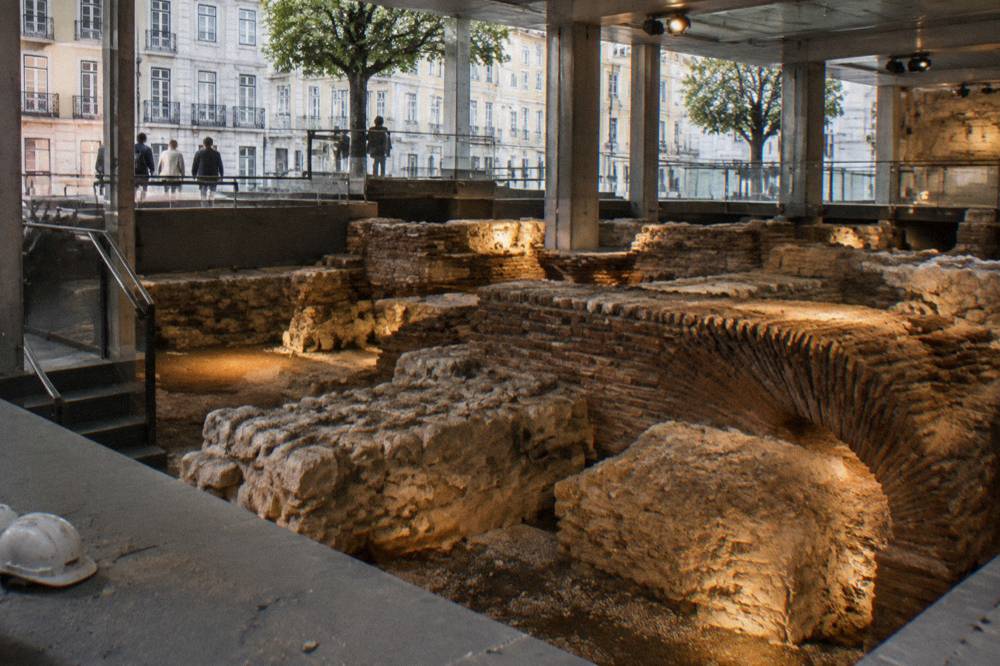
The most direct free trace is underground. The Núcleo Arqueológico da Rua dos Correeiros, at Rua dos Correeiros 9, is a free archaeological site showing Roman and Pombaline layers, including the Pombaline cage construction. Every visit is guided, in Portuguese or English, and booking is required through the Fundação Millennium bcp; visits run every day except Sundays and national holidays. It is the one place in the city where you can see the layers the earthquake and the rebuilding sit on, and it costs nothing.
| Site | What you see | Cost and condition |
|---|---|---|
| Baixa grid | The rebuilt downtown street plan | Free public streets |
| Praça do Comércio | The square rebuilt from 1756 on the palace site | Free public square |
| Rua Augusta Arch passage | Walking through the arch | Free |
| Rua Augusta Arch viewpoint | The platform on top | Paid, free with Lisboa Card |
| Rua dos Correeiros site | Roman and Pombaline layers | Free, guided, booked in advance |
| Carmo Convent ruins | The church left ruined | EUR 7, no free day |
If you would rather have the story told while you walk, three free, pay what you want tours cover this ground, and the full list of options is in the guide to free walking tours in Lisbon.
Is The Carmo Convent Free Or Ticketed?
The Carmo Convent ruins are ticketed: EUR 7 for adults, with reduced rates of EUR 5 for students, visitors over 65, Lisboa Card holders, Portuguese residents and groups of 30 or more, and free entry for children up to 14 with an adult. There is no free day listed, and it is closed on Sundays.
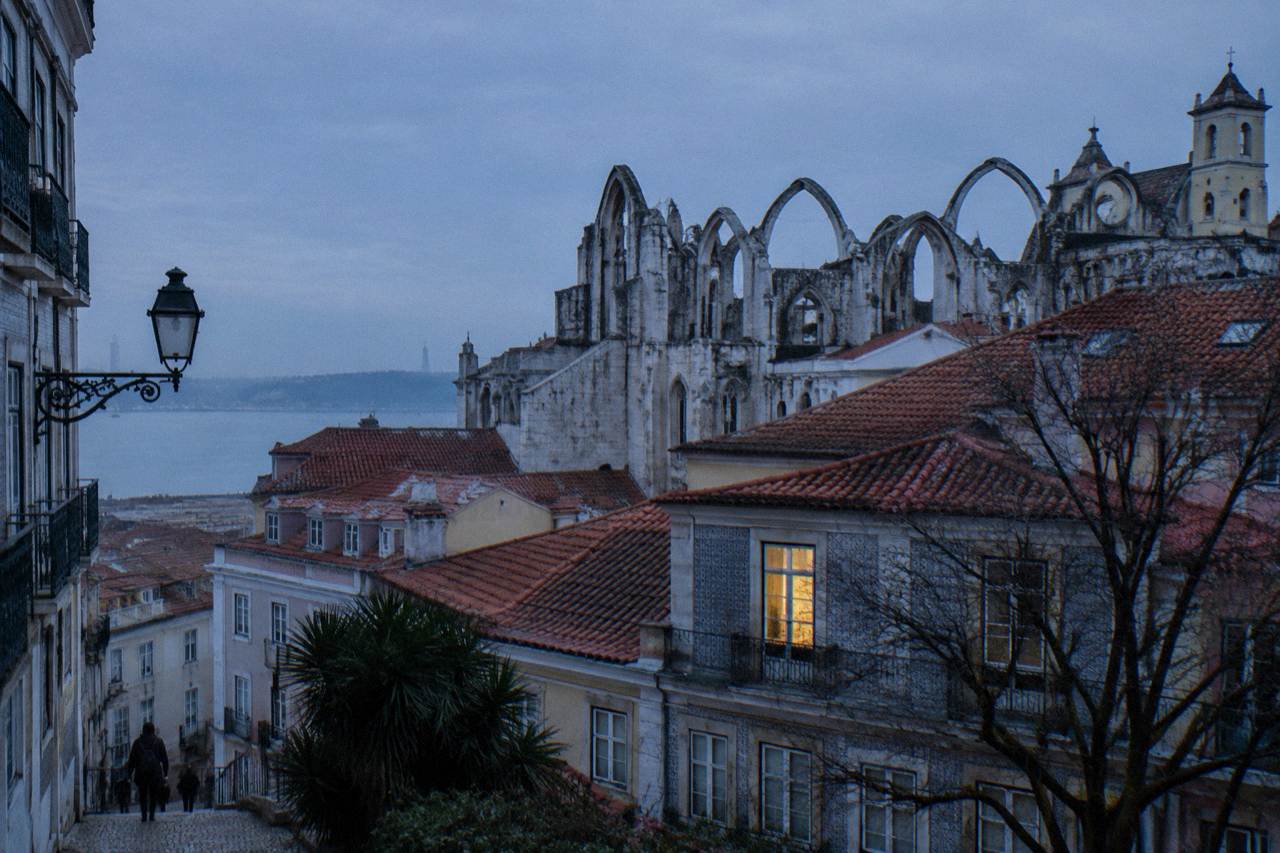
The Carmo is the earthquake's most famous image: a gothic church whose roof burned and collapsed, left standing open to the sky ever since. Today the ruins house the Museu Arqueológico do Carmo, and visiting them means buying a ticket. The pricing is straightforward: EUR 7 standard, EUR 5 for students, visitors over 65, Lisboa Card holders, Portuguese residents and groups of 30 or more, free for children up to 14 accompanied by an adult, free for reduced-mobility visitors with a companion, and free for ICOM members. What the official page does not list is any free day, so treat the Carmo as a paid stop and budget for it.
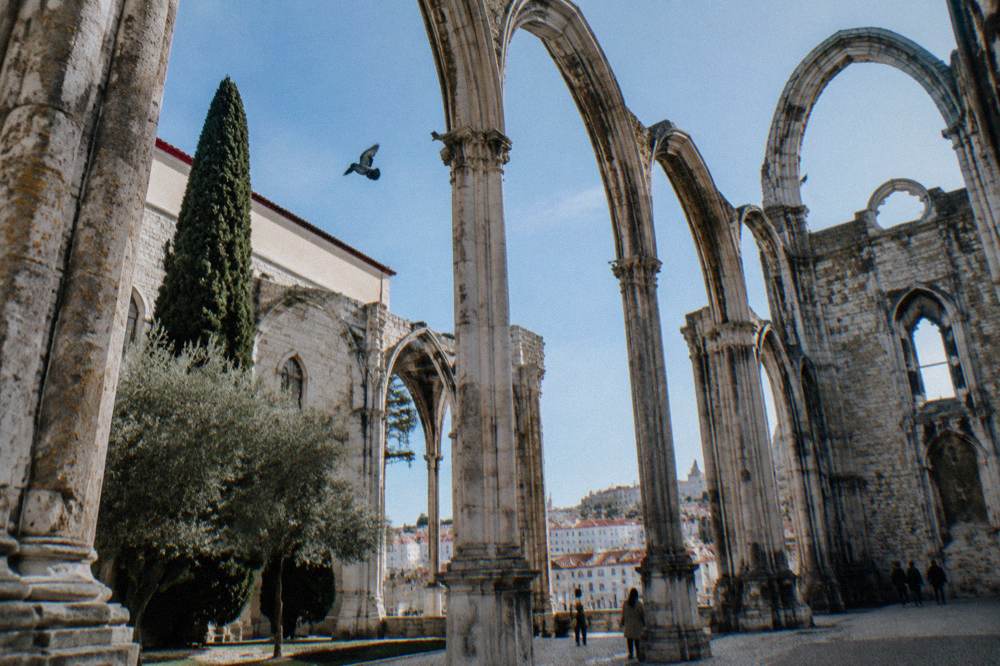
Opening hours follow the seasons. From November to April it opens Monday to Saturday, 10:00 to 18:00, with last entry at 17:40; from May to October, 10:00 to 19:00, with last entry at 18:40. Easter week and the period from 26 December to 6 January follow the longer hours. It closes on Sundays and on 1 January, 1 May and 25 December. Getting there is easy: tram 28, the Baixa-Chiado metro station and bus 758 all serve the area.
| Ticket | Price |
|---|---|
| Adult | EUR 7 |
| Students, over 65, Lisboa Card, Portuguese residents, groups of 30+ | EUR 5 |
| Children up to 14 with an adult | Free |
| Reduced mobility with companion | Free |
One contrast is worth making plainly: the Carmo is the paid earthquake site, while the free 1755 record is the Baixa grid, Praça do Comércio and the booked Rua dos Correeiros visit. A commercial simulator attraction, the Quake museum, is also paid, with adult tickets from EUR 23.50 to 29.50 depending on time and season, so the free options above are the ones that cost nothing.
Why Is The Baixa Laid Out As A Grid?
The Baixa grid exists because the earthquake destroyed the old downtown, and the reconstruction under the Marquis of Pombal rebuilt it on a rational plan with parallel streets and earthquake-resistant gaiola pombalina timber framing. The uniform layout you walk today is the 1755 rebuilding, and the streets themselves cost nothing to explore.
Before 1755 the downtown was a tangle of medieval streets. The destruction was so complete that the rebuild could start from a plan, and the plan chosen was a grid: parallel streets, uniform facades, a central axis running from the new Praça do Comércio up to Rossio. The name Baixa Pombalina records the minister behind it, and the construction technique inside the walls, the gaiola pombalina or Pombaline cage, a timber frame designed to flex rather than collapse, is why the district is cited on UNESCO's Tentative List.
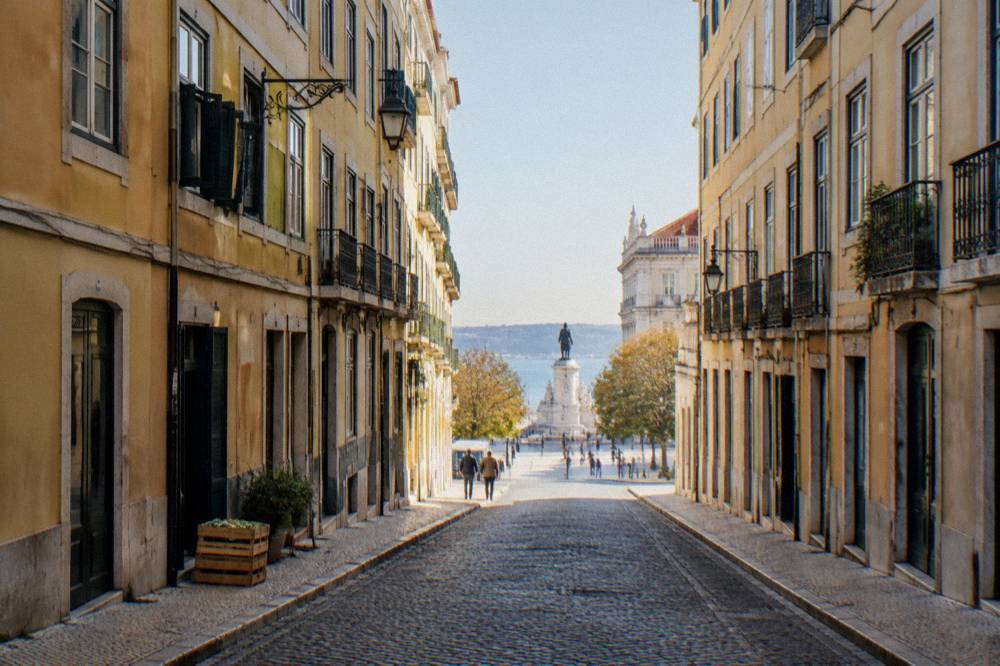
Reading the grid on foot is free, and it is the kind of walk that rewards an explanation. The Downtown Lisbon With A PhD Student Walk, 3 Hours 30, listed on GuruWalk by the guide Eduardo, meets at Rossio Square, runs in English and is rated 5 out of 5 across 775 GuruWalk reviews. It is free, pay what you want, like every walk on this site's roster. See this free tour if the deep downtown story is what you are after.
The grid also explains a quirk visitors notice immediately: the street names in the Baixa follow a system, with streets named for trades and crafts, part of the ordered thinking behind the rebuild. The uniform facades were standardised so the district could be built fast and repaired uniformly, and the whole plan was an early exercise in what would now be called urban planning. You can see the same story from the water side in the guide to Praça do Comércio and the Rua Augusta Arch, where the square rebuilt from 1756 anchors the grid's river end.
Which Free Walking Tours Cover The Earthquake?
The free walk built around the earthquake story is the Baixa Chiado, 1755 Earthquake tour on GuruWalk, rated 4.79 out of 5 across 583 GuruWalk reviews, meeting at Praça do Comércio and running 2 hours 30 minutes in English. Other downtown walks on GuruWalk and freetour.com cover the rebuilt streets on a pay what you want basis.
The Baixa Chiado, 1755 Earthquake walk, run by Hi Lisbon Walking Tours and listed on GuruWalk, is the one whose whole subject is the disaster and the rebuilding. It meets at Praça do Comércio, the square the rebuilding created, runs 2 hours 30 minutes in English, and is rated 4.79 out of 5 across 583 GuruWalk reviews. Like every walk on this site, it is free, pay what you want: you reserve a place and pay the guide what you think the walk was worth at the end.
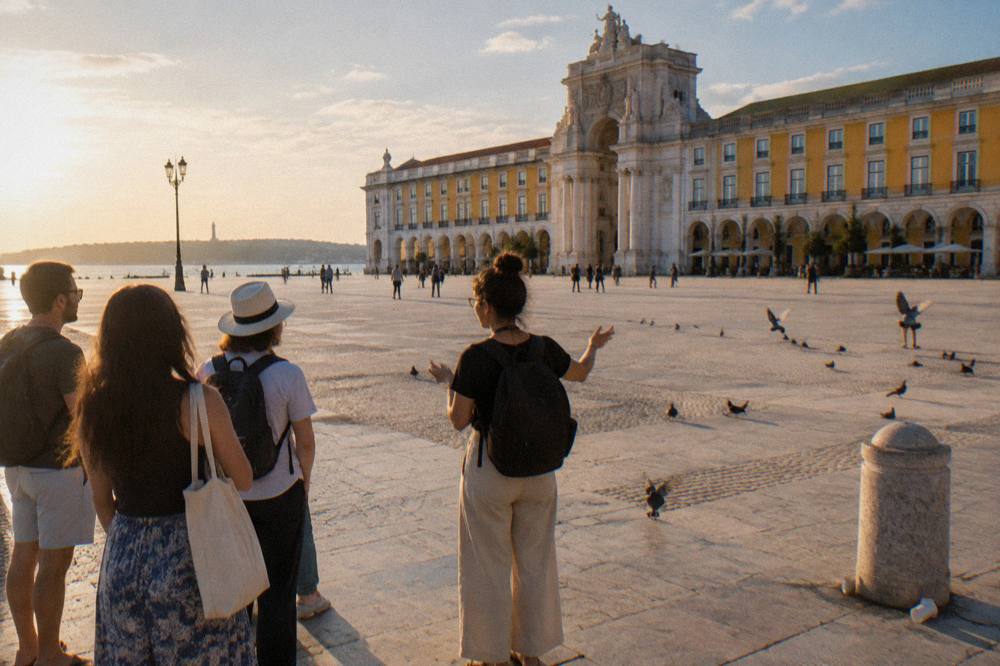
Beyond that walk, the downtown roster gives you a choice of formats. The Essential History, Free Tastings walk by Tours Of My Life on GuruWalk, rated 4.96 out of 5 across 25,140 GuruWalk reviews, runs 3 hours in English and Spanish from Praça Luís de Camões. The SANDEMANs Original Walk, listed on freetour.com, is rated 9.4 out of 10 across 14,048 freetour.com reviews and runs 2 hours in English and Spanish from Praça do Comércio. A shorter option, the Local's Eyes Walk, 1 Hour 30, meets at Rossio Square and is rated 4.93 out of 5 across 350 GuruWalk reviews.
| Walk | Platform | Rating and reviews | Duration | Language |
|---|---|---|---|---|
| Baixa Chiado, 1755 Earthquake | GuruWalk | 4.79 out of 5 across 583 GuruWalk reviews | 2 hours 30 minutes | English |
| Essential History, Free Tastings | GuruWalk | 4.96 out of 5 across 25,140 GuruWalk reviews | 3 hours | English and Spanish |
| SANDEMANs Original Walk | freetour.com | 9.4 out of 10 across 14,048 freetour.com reviews | 2 hours | English and Spanish |
| Local's Eyes Walk, 1 Hour 30 | GuruWalk | 4.93 out of 5 across 350 GuruWalk reviews | 1 hour 30 minutes | English |
Every one of these is free, pay what you want, reserved on its platform, with no separate required cost declared on any listing. For how the pay what you want model works in practice, see are free walking tours really free.
Which Free Squares Show The Rebuilding?
The free squares that show the rebuilding are Praça do Comércio, rebuilt from 1756 on the site of the destroyed royal palace, and the Rossio and Praça da Figueira end of the grid, all free public space. The Rua Augusta Arch passage is free to walk through, while the arch viewpoint is paid, and the Marquis of Pombal statue stands at the top of Avenida da Liberdade.
Praça do Comércio is the rebuilding's signature: the square was rebuilt from 1756 on the site of the Paço da Ribeira, the royal palace destroyed in 1755. Standing in it costs nothing, and the open plan facing the river is the Pombaline idea made visible, a formal square where the palace complex stood. Walking through the Rua Augusta Arch on its north side is also free; the viewpoint on top, which opened to the public on 9 August 2013, is a paid attraction, free with the Lisboa Card, and the adult price is not published on the official page.
The other end of the story stands uptown. The statue of the Marquis of Pombal stands at the top of Avenida da Liberdade in Praça do Marquês de Pombal, next to Parque Eduardo VII, a free public park. It is the rebuilding's monument to its own organiser, and the plaza around it is free public space. For the neighbourhoods that survived the earthquake rather than being rebuilt, the hills of Alfama and Mouraria, see the guide to Mouraria and Graça.
For a walk that connects the rebuilt downtown with the Bairro Alto side, the Downtown And Bairro Alto, 3 Hours tour on GuruWalk, run by Live History, meets at Rossio Square, runs 3 hours in English and Spanish and is rated 4.78 out of 5 across 214 GuruWalk reviews. It is free, pay what you want, like the rest of the roster.
If you want to keep exploring the rebuilt city with a guide, three more free walks fit the same ground: the Original Local, 3 Hours walk listed on freetour.com, rated 9.6 out of 10 across 6,630 freetour.com reviews, running 3 hours in English from Praça Luís de Camões; the Local's Eyes Walk, 1 Hour 30 on GuruWalk; and the Old Neighborhoods And Stories walk by Tours Of My Life on GuruWalk, rated 4.92 out of 5 across 353 GuruWalk reviews, running 2 hours 45 minutes in English, Spanish and French. Each is free, pay what you want, and this site, Free Things To Do In Lisbon, names the platform for every walk it covers.
Common Questions About The 1755 Earthquake
What Happened In The 1755 Lisbon Earthquake?
An earthquake struck Lisbon at about 9:30 to 9:40 in the morning on 1 November 1755, All Saints Day, followed by tsunami waves of about six metres and fires that burned for about six days. Death estimates range from about 30,000 to 60,000 in the city, and magnitude estimates run from about 7.7 to 8.7.
Is The Carmo Convent Free Or Ticketed?
The Carmo Convent ruins are ticketed: EUR 7 for adults, EUR 5 for students, visitors over 65, Lisboa Card holders, Portuguese residents and groups of 30 or more, and free for children up to 14 with an adult. No free day is listed, and it is closed on Sundays.
Where Can You See Earthquake Traces For Free?
The free traces are the Baixa grid, Praça do Comércio and the Núcleo Arqueológico da Rua dos Correeiros, a free guided archaeological visit that must be booked in advance and runs every day except Sundays and national holidays. The Carmo ruins and the Rua Augusta Arch viewpoint are paid.
Why Is The Baixa Laid Out As A Grid?
The earthquake destroyed the old downtown, and the reconstruction under the Marquis of Pombal rebuilt it on a rational grid plan with earthquake-resistant gaiola pombalina timber framing. The uniform streets you walk today are the 1755 rebuilding.
Which Free Walking Tours Cover The Earthquake?
The Baixa Chiado, 1755 Earthquake walk on GuruWalk, rated 4.79 out of 5 across 583 GuruWalk reviews, meets at Praça do Comércio and runs 2 hours 30 minutes in English. Other downtown walks on GuruWalk and freetour.com cover the rebuilt streets, all free and pay what you want.
Is The Rua Augusta Arch Viewpoint Free?
Walking through the Rua Augusta Arch is free. The viewing platform on top, which opened to the public on 9 August 2013, is a paid attraction that is free with the Lisboa Card; the adult price is not published on the official page.