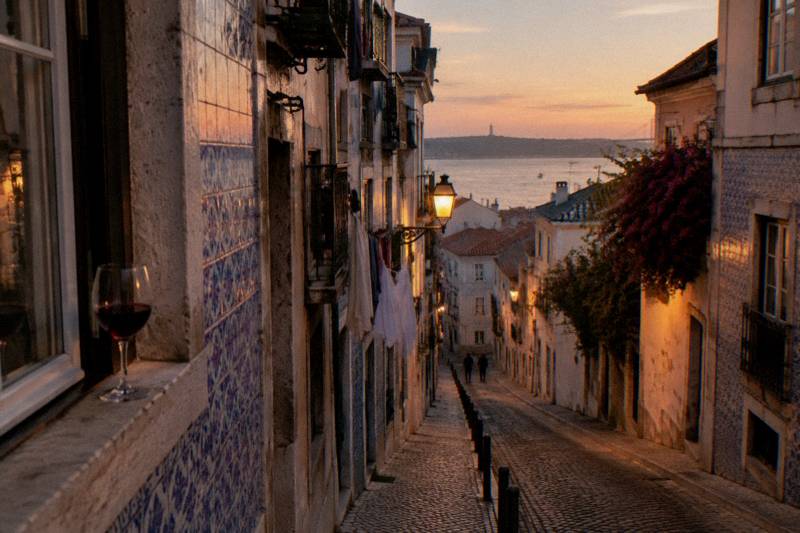
Alfama Lisbon: What To See For Free In The Old Town
Alfama is the oldest district in Lisbon, a tangle of lanes climbing from the river to the castle hill, and most of what makes it worth visiting costs nothing: the streets, the squares, the viewpoints and, on the right nights, the singing.
Short answer
Alfama's streets, squares and viewpoints are free to walk, including Miradouro de Santa Luzia and Miradouro das Portas do Sol. The Lisbon Cathedral charges EUR 7 for the tourist visit, with only the prayer space free, and Sao Jorge Castle is ticketed at EUR 17. Free walking tours of the district run on GuruWalk and freetour.com.
Alfama sits on the hill between the River Tagus and the castle, and it is the part of Lisbon that survived the 1755 earthquake more or less intact. That is the whole reason it looks the way it does: while the Baixa was rebuilt on a grid, Alfama kept its medieval layout of narrow lanes, dead ends and stairways, a district of washing lines, tiled facades and small squares that grew organically over centuries. It is also, for a visitor watching a budget, the most generous part of the city. The things that make Alfama famous, its streets, its viewpoints and its fado, are either free outright or free under conditions that are easy to meet. The paid items, the castle, the cathedral's tourist visit, the museums nearby, sit beside a free layer that is bigger than most visitors expect.
This guide walks through that free layer district by district: what costs nothing, what carries a ticket, where the free walking tours meet, and what happens after dark. The prices and free conditions below are the operators' own, so they are the ones you will meet at the door, though they can change.
What Is Free To Do In Alfama?
The free core of Alfama is the district itself: its lanes, stairways and squares cost nothing to explore, and the public viewpoints of Santa Luzia and Portas do Sol are free open spaces. The paid items sit inside that free layer, with the castle at EUR 17, the cathedral's tourist visit at EUR 7 and the nearby Museu do Fado at EUR 5. Walking the hill is free; entering its monuments mostly is not. One of the free walking routes passes through here: Take's Alfama Old Town.
That split, free ground and paid interiors, is the single most useful thing to understand about Alfama. The Castelo hill is free to climb, its lanes are free to wander and its viewpoints are free public spaces, but Sao Jorge Castle itself is a ticketed monument at EUR 17. The same pattern repeats across the district. A church may welcome you into a space for prayer at no cost while charging for the sightseeing visit. A square is open to everyone while the tower above it sells tickets.
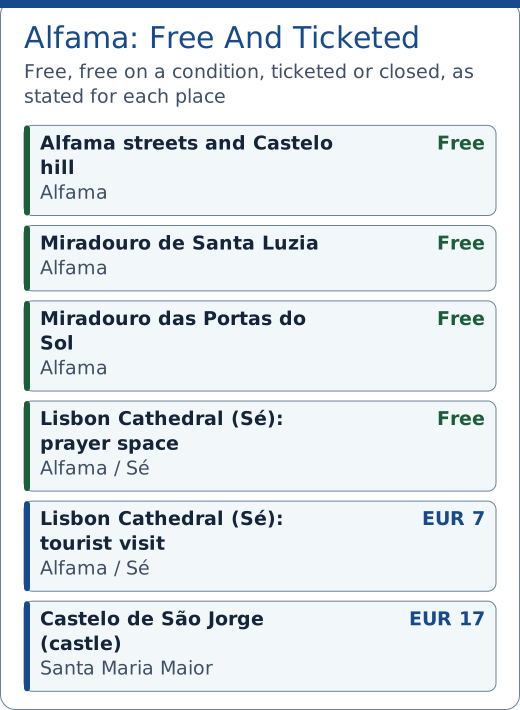
For planning, the honest table looks like this. Each line is a real place in or on the edge of Alfama, with its status stated plainly.
| Place | Status | Condition |
|---|---|---|
| Alfama lanes, stairways and squares | Free | Open public streets |
| Miradouro de Santa Luzia | Free | Open public viewpoint |
| Miradouro das Portas do Sol | Free | Open public viewpoint |
| Sao Jorge Castle | Paid | EUR 17, ticketed monument |
| Lisbon Cathedral, prayer space | Free | Space reserved for those who come to pray |
| Lisbon Cathedral, tourist visit | Paid | EUR 7, visits limited during worship |
| Museu do Fado | Paid | EUR 5, with free categories for children and card holders |
| Tram 28 through the district | Paid | EUR 3.30 bought on board |
One caution belongs here because it catches a lot of visitors. The old idea that monuments in Lisbon are free on Sundays no longer describes the rules for tourists. National monuments run by Museus e Monumentos de Portugal replaced their Sunday scheme with a programme of 52 free days a year for residents of Portugal, who prove it with a Citizen Card. Visitors pay on every day of the week. Municipal museums run a Sunday morning window for residents of the Lisbon municipality. Neither is a visitor fact, and neither should shape your plans.
The practical conclusion is simple. Give Alfama a long morning or a long evening on foot, because the walking is the attraction, and treat the ticketed interiors as deliberate choices rather than defaults. A day spent entirely on the free layer, lanes, viewpoints, the riverfront and the singing in the evenings, is not a compromise version of the district. It is the version most locals would recommend anyway.
Which Free Miradouros Sit Inside Alfama?
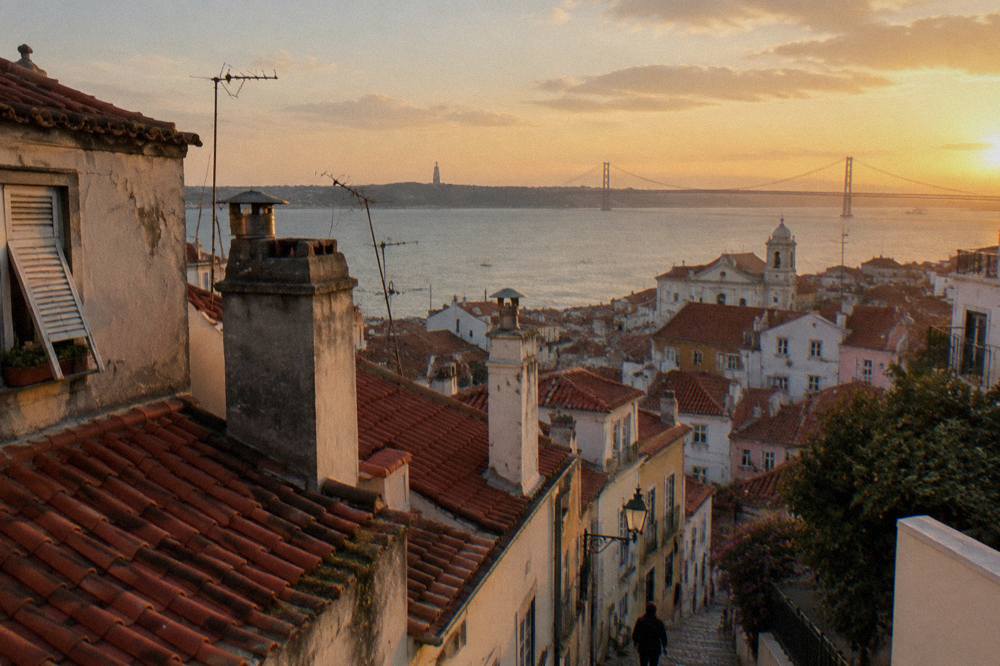
Two of Lisbon's best known viewpoints sit inside Alfama itself: Miradouro de Santa Luzia, a garden terrace with a pond, azulejo panels and a kiosk, and Miradouro das Portas do Sol, a public terrace with its own kiosk a few steps uphill. Both are free open public spaces with no ticket, no gate and no closing booth, and both look east over the Alfama rooftops to the river.
Santa Luzia is the more ornamental of the two. The terrace is a small garden with a pond, decorative tiled panels on the wall and a kiosk for coffee, and the platform looks out over the church domes and roof terraces of lower Alfama toward the Tagus. It is described on the official Visit Lisboa page for the viewpoint as a free public viewpoint, and that is exactly what it is: an open space you walk into. Portas do Sol sits a short climb higher and does the same job with a wider frame, a long terrace over the Alfama valley with a kiosk and a steady stream of people at sunset.
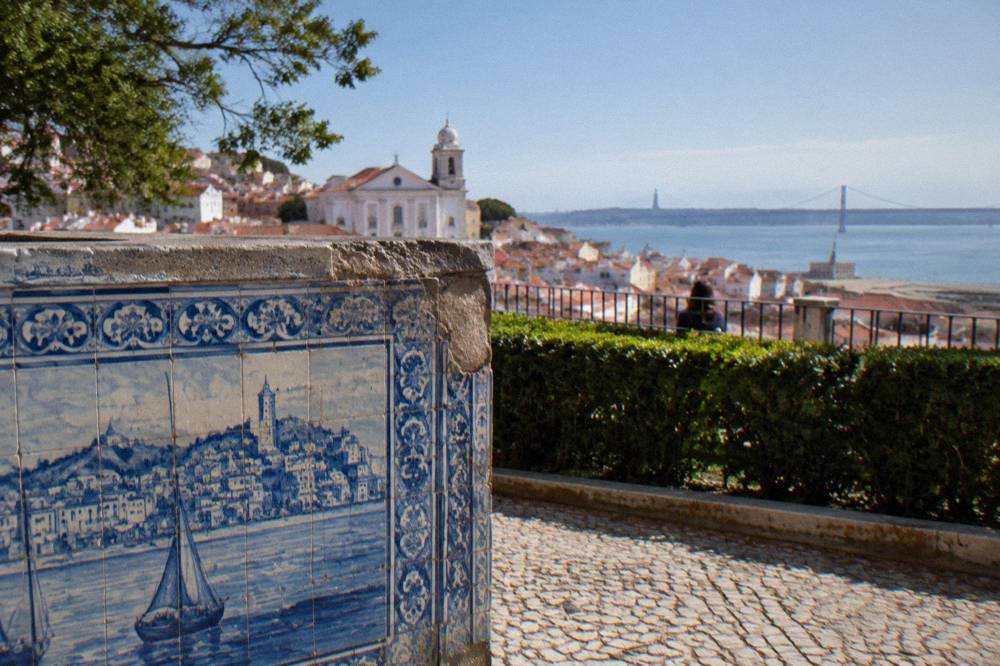
Beyond the two inside the district, the hill country above Alfama adds more free terraces in the neighbouring Graça quarter, including the Miradouro da Graça, which the city's own listing describes as open 24 hours, and the Miradouro da Senhora do Monte. Those sit outside Alfama proper, and this site covers the full set, with hours and character, in a separate guide to Lisbon's free viewpoints. If you are routing a day, the honest advice is this: do Santa Luzia and Portas do Sol on your way up through Alfama, then keep climbing. This stop sits on a free walking route, Take's Alfama Old Town.
| Viewpoint | Where | What it is | Cost |
|---|---|---|---|
| Miradouro de Santa Luzia | Largo das Portas do Sol e de Santa Luzia | Garden terrace, pond, azulejo panels, kiosk | Free |
| Miradouro das Portas do Sol | Top of Alfama, by Santa Luzia | Open terrace with kiosk, wide district view | Free |
| Miradouro da Graça | Calcada da Graça, above the district | Open 24 hours per the city listing | Free |
| Miradouro da Senhora do Monte | Rua da Senhora do Monte, Graça | Panoramic public terrace | Free |
Because the viewpoints are the district's biggest free draw, several free walking tours build their route around them, and a guided walk is a reasonable way to see the hill without planning the climb yourself. The walks below all run on a pay what you want basis, reserved in advance on their platforms, and the trio spans an Alfama-focused walk, a castle-exterior walk and a longer essentials walk with tastings.
Is The Lisbon Cathedral Free To Enter?
The Lisbon Cathedral, the Sé, is not free for sightseeing: the tourist visit to the naves, deambulatory, High Choir and Treasury costs EUR 7, with hours from 10:00 to 18:00 in winter and 09:30 to 19:00 in summer, closed Sundays and holy days. A separate space is reserved for prayer and is free for those who come to pray, with visits limited during worship.
That distinction, prayer space against tourist visit, is the whole answer, and it comes straight from the cathedral's own ticketing page. The Sé is a working church first and a monument second, and its official terms reflect that. If you enter to pray, the space kept for prayer is free. If you enter to see the church, you are buying the tourist visit at EUR 7, and the visit is restricted around services.
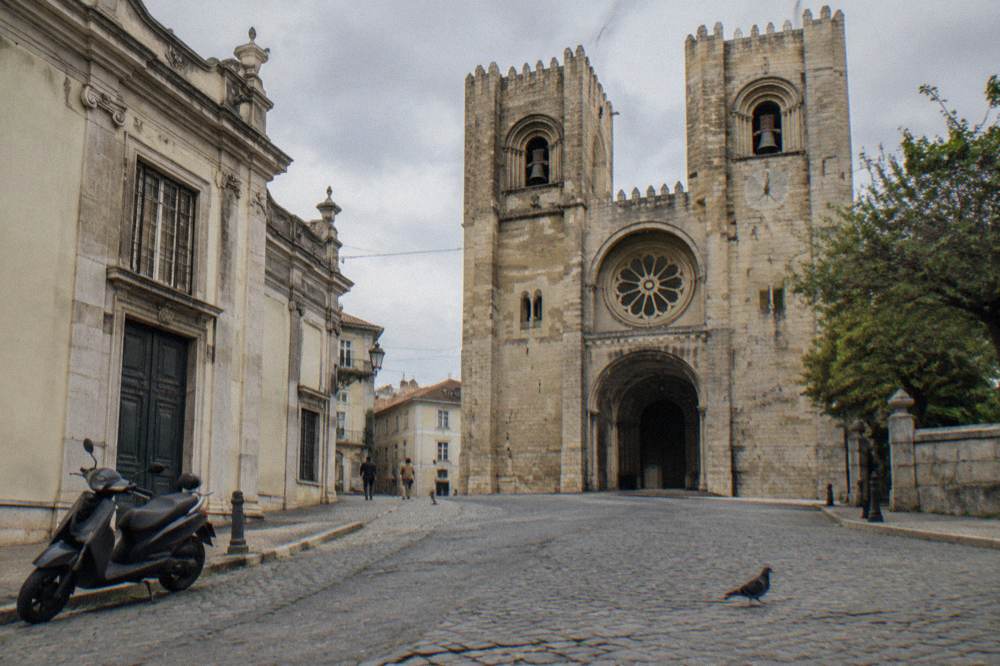
The hours are worth writing down before you go, because the weekly rhythm is unusual for a major church. From November to May the visit runs Monday to Saturday, 10:00 to 18:00. From June to October it runs Monday to Saturday, 09:30 to 19:00. It is closed on Sundays and on holy days, and the last entry is 45 minutes before closing in both seasons. The cloister price is not named on the official page, so treat the cloister as part of the ticketed visit and confirm at the desk. The cathedral's own ticket page is the source for all of this, and it is the page to re-check before a visit, since churches adjust hours around ceremonies.
What you do not need a ticket for is the setting. The Sé sits at the top of the Alfama slope where the district begins its climb from the river, and the streets around it, the lanes running down toward the Tagus, the small squares, the walk up to Portas do Sol, are all free public ground. Many visitors get the cathedral's exterior, its Romanesque front and fortified towers, the surrounding lanes and both free viewpoints in a single free loop, then decide whether the interior is worth EUR 7 to them. That is a reasonable way to do it.
Can You Walk Up To Sao Jorge Castle For Free?
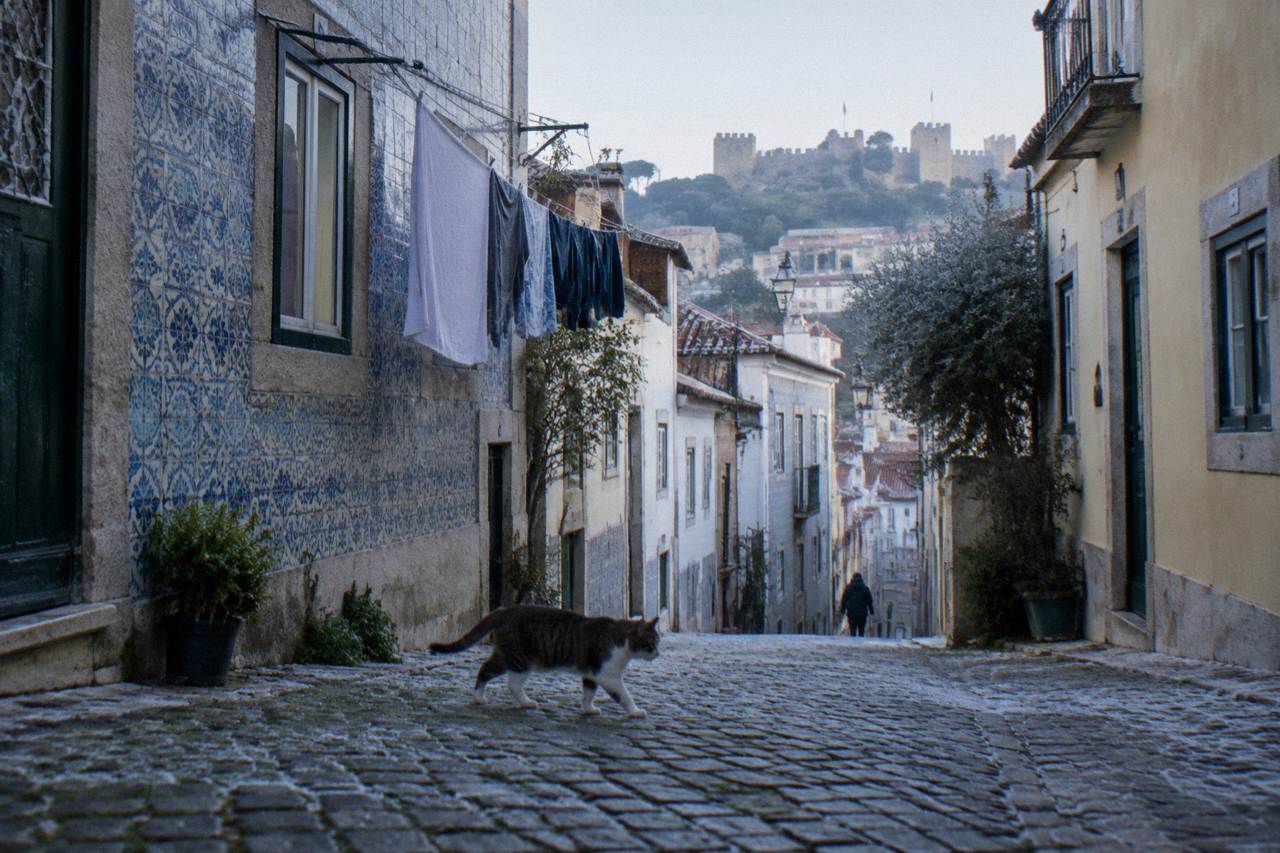
Yes, the walk up to the castle is free: the Castelo hill, its lanes and the small squares around the castle entrance are public streets, and you can stand at the gates and see the district without paying anything. Entering Sao Jorge Castle itself is not free, it is a ticketed monument at EUR 17, and the free experience is the hill and the approach, not the walls and grounds.
The castle is the one hard border in Alfama's free layer. Everything below and around it, the lanes of the old Moorish quarter, the viewpoints, the squares with their kiosks, is open public space. The monument inside the walls belongs to a different category: a paid national site, EUR 17 for a visitor, with free entry only for under-13s and Lisboa Card adults. Lisbon residents lost their own free entry on 3 July 2025. This site looks at the castle's status in detail in a separate piece, Is Sao Jorge Castle Free?, and the short answer there is the same as here: the hill is free, the castle is not.
Getting up the hill deserves a note on transport, because two famous options are not what visitors sometimes assume. Tram 28 runs through the district and up the slope, but it is a paid ride, EUR 3.30 for a ticket bought on board, and the Carris 2026 price table is the official source for that fare. The Santa Justa lift and the Gloria, Bica and Lavra funiculars, the other historic lifts visitors read about, are marked out of service by Carris, with no reopening date, so no plan should rely on them. The Graça funicular on the neighbouring hill did reopen on 30 April 2026, but it carries a fare of EUR 4.30 for two trips and it serves Graça, not the castle approach.
On foot, then, is the honest answer, and it is a good one. The climb from the river through Alfama's lanes to the castle gates takes in most of what the district is famous for, costs nothing, and lands you at the monument's entrance where the decision about the EUR 17 ticket can be made with the walls in front of you. Wear shoes with grip: the calçada paving of white limestone and black basalt is laid by hand, beautiful, and famously slippery on slopes, especially when wet.
Where Does The Alfama Free Walking Route Start And End?
The main free walking tours of Alfama start at fixed meeting points at the district's edges and finish inside it after around two and a half hours. Alfama Secrets by Hi Lisbon meets at Praça do Comércio; Take's Alfama Old Town meets at Rua dos Bacalhoeiros 12. Both run in English, both are free, pay what you want, and both are reserved on GuruWalk. This stop sits on a free walking route, Take's Alfama Old Town.
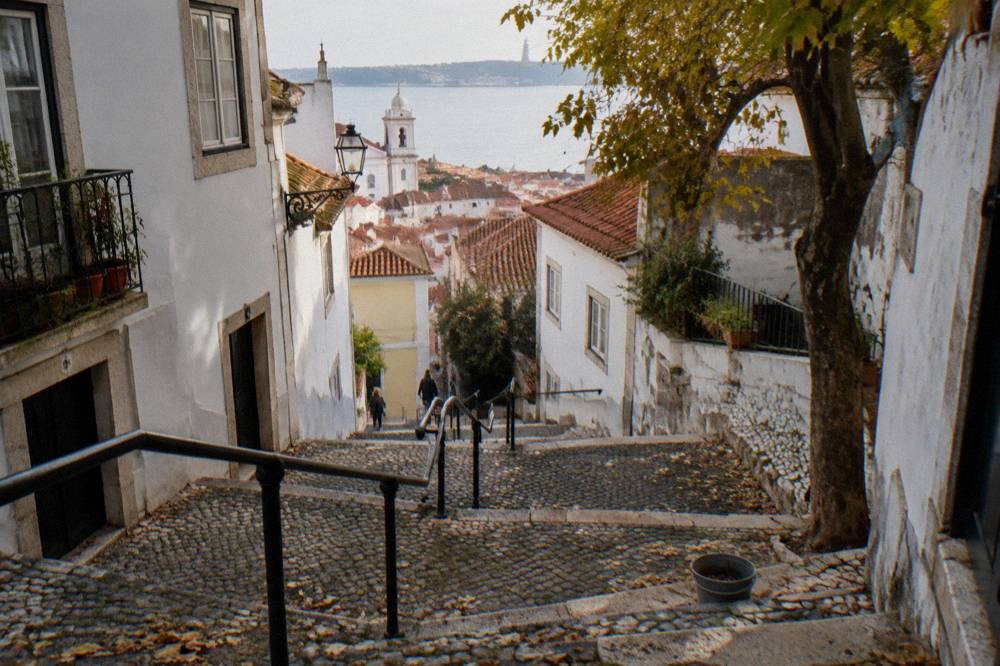
A self-guided route is straightforward, and the district almost designs it for you. Start at the river, at Praça do Comércio or the Ribeira das Naus promenade, both free public ground, and climb into Alfama from the south. The lanes funnel you upward past the Sé, whose exterior and square cost nothing, then up through the staggered squares to Santa Luzia and Portas do Sol. From Portas do Sol the lane continues toward the castle gates, and the whole climb is free public street. Coming down, the stairways on the northern side drop you toward the Pantheon area, where the viewpoints around the Pantheon are free while the monument and its terrace inside are ticketed.
If you would rather have a guide for that climb, the free walking tours do the same job with the history attached. Alfama Secrets, run by Hi Lisbon Walking Tours, meets at Praça do Comércio and runs two hours 30 minutes in English, rated 4.78 out of 5 across 1,706 GuruWalk reviews. Take's Alfama Old Town meets at Rua dos Bacalhoeiros 12, at the district's river edge, and runs two hours 30 minutes in English, Spanish, French and Italian, rated 4.85 out of 5 across 1,402 GuruWalk reviews. Both are reserved free on GuruWalk, with each walker paying the guide what they consider the walk worth at the end.
Take's walk suits households with mixed languages, since the same listing runs in four, and its meeting point at Rua dos Bacalhoeiros 12 puts you inside the old town from the first minute rather than walking in from the square. The two walks overlap in territory, the lanes, the hill, the viewpoints, and differ in guide and in starting point, so the choice between them usually comes down to language and to where your day is already headed.
A third option stretches the route further. Alfama And Mouraria, 3 Hours, run by Live History, meets at Rossio Square on the district's western side and runs three hours in English and Spanish, rated 4.71 out of 5 across 722 GuruWalk reviews on GuruWalk. It is the pick if you want the longer format, and it is covered with the other walks below.
What Is Free In Alfama After Dark?
After dark, Alfama's free layer is the fado sung in small eateries and the district's lanes and viewpoints under lights: fado vadio, amateur and spontaneous singing, runs in simple tascas around the square beside the church of Sao Miguel, where drinks are the cost and the singing itself is not ticketed. The formal fado houses are paid venues, and the Museu do Fado nearby charges EUR 5, so the free evening is built on the informal side of the tradition. This stop sits on a free walking route, Take's Alfama Old Town.
Fado is the district's night music and it was inscribed by UNESCO on the Representative List of the Intangible Cultural Heritage of Humanity in 2011 as the urban popular song of Portugal. In Alfama that heritage has two faces. The formal face is ticketed: dedicated fado houses and the Museu do Fado, at Largo do Chafariz de Dentro, which charges EUR 5 for its normal ticket and opens Tuesday to Sunday until 18:00. The informal face is fado vadio, amateur singing in small eateries, and the official city fado route describes it plainly: around the square beside the church of Sao Miguel, simple eateries open onto the square and fado vadio is sung there. You pay for what you drink; the singing has no ticket window. Door policies vary by house and by night, so confirm at the door rather than assuming a minimum spend.
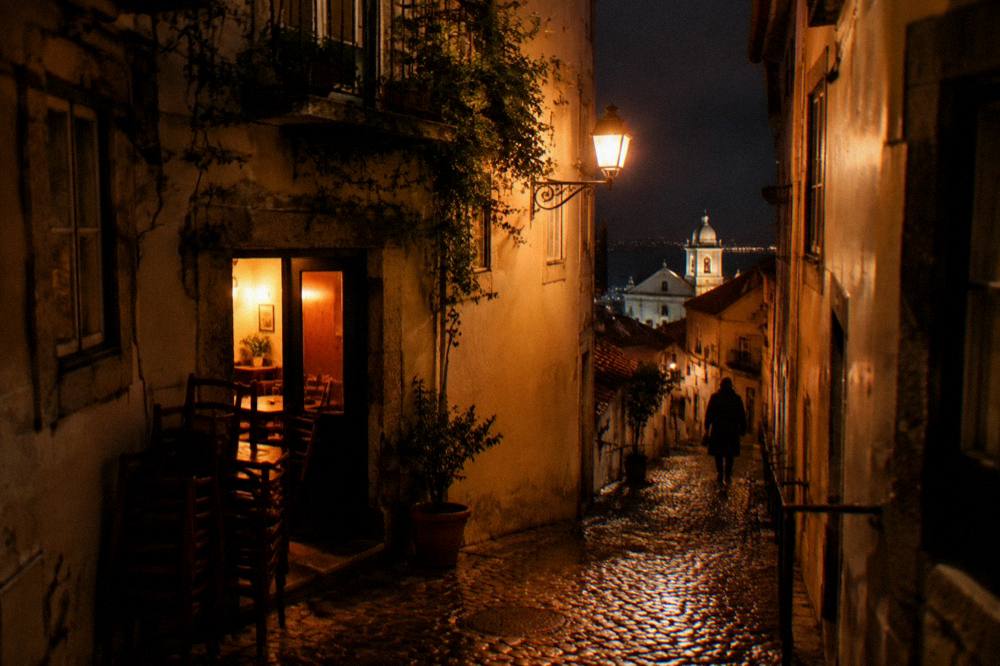
The other free evening pieces are the ones the daytime already gave you, seen in different light. Portas do Sol and Santa Luzia stay open public terraces after sunset, and the lanes between them, under lamps, with washing lines and radio noise, are the district at its most atmospheric. The riverfront at the bottom of the hill is free public promenade. None of it closes at a stated hour the way a museum does, though kiosks and eateries keep their own hours, so an evening in Alfama is best treated as a walk with a tavern stop rather than a timed event.
For the wider picture, including where the free singing sits against the paid fado houses across the city, this site has a full guide to free fado in Lisbon. For Alfama specifically, the practical formula is this: walk the lanes, find the square by Sao Miguel, pick a tasca with singing, and budget for dinner rather than for a show.
Which Free Walking Tours Meet In Alfama?
The free walking tours that cover Alfama meet at fixed points around the district's edges: Praça do Comércio for Alfama Secrets by Hi Lisbon, Rua dos Bacalhoeiros 12 for Take's Alfama Old Town, and Rossio Square for the Alfama And Mouraria walk by Live History and the Alfama Walk with castle exterior by Discover. All are free, pay what you want, reserved on GuruWalk. One of the free walking routes passes through here: Take's Alfama Old Town.
The two walks not yet covered in this guide both meet at Rossio Square, on the western side of the climb. Alfama And Mouraria, 3 Hours, by Live History, runs three hours in English and Spanish and is rated 4.71 out of 5 across 722 GuruWalk reviews. The Alfama Walk with castle exterior, by Discover, runs two hours 30 minutes in English and is rated 4.83 out of 5 across 491 GuruWalk reviews. Across these Alfama listings on GuruWalk, ratings run from 4.71 to 4.85 out of 5, over review pools that stretch from 491 to 1,706 reviews. As with every walk on this site, no route stop list is published for these listings, so judge them by guide, meeting point, language and duration rather than by promised landmarks.
| Walk | Guide or operator | Meets at | Duration | Rating |
|---|---|---|---|---|
| Alfama Secrets, Hi Lisbon | Hi Lisbon Walking Tours | Praça do Comércio | 2 hours 30 | 4.78 out of 5 across 1,706 GuruWalk reviews |
| Take's Alfama Old Town | Take | Rua dos Bacalhoeiros 12 | 2 hours 30 | 4.85 out of 5 across 1,402 GuruWalk reviews |
| Alfama And Mouraria, 3 Hours | Live History | Rossio Square | 3 hours | 4.71 out of 5 across 722 GuruWalk reviews |
| Alfama Walk, Castle Exterior | Discover | Rossio Square | 2 hours 30 | 4.83 out of 5 across 491 GuruWalk reviews |
Beyond the district, the same free model covers the whole city, and a first day in Lisbon often pairs an Alfama walk with a general essentials walk. Unmissable Essentials by Take meets at Praça dos Restauradores and runs two hours 45 minutes in four languages, rated 4.87 out of 5 across 6,312 GuruWalk reviews. Original Local, 3 Hours, by Original Lisbon Tours, meets at Praça Luís de Camões and is listed on freetour.com, rated 9.6 out of 10 across 6,630 freetour.com reviews. Local's Eyes Walk, 1 Hour 30, by Francisco, meets at Rossio Square and is rated 4.93 out of 5 across 350 GuruWalk reviews. This site compares the full field, including these, in its guide to free walking tours in Lisbon, and Free Things To Do In Lisbon covers the rest of the city's free layer, from Belém's riverside to the parks of the Avenidas Novas.
Common Questions About Alfama
Is Alfama Free To Visit?
The district itself is free: its lanes, stairways, squares and viewpoints are public streets and open spaces with no ticket. The paid items sit inside that free layer, mainly Sao Jorge Castle at EUR 17, the cathedral's tourist visit at EUR 7 and the Museu do Fado at EUR 5. A full day on Alfama's free layer is entirely possible.
Which Alfama Viewpoints Are Free?
Miradouro de Santa Luzia and Miradouro das Portas do Sol are both free open public viewpoints inside Alfama, each with a kiosk. Above the district, the Graça and Senhora do Monte terraces in the neighbouring quarter are also free, and the city's own listing describes the Graça viewpoint as open 24 hours.
Can You Enter The Lisbon Cathedral For Free?
Only the space reserved for prayer is free, for those who come to pray. The tourist visit to the naves, deambulatory, High Choir and Treasury costs EUR 7 and runs Monday to Saturday, closed Sundays and holy days, with the last entry 45 minutes before closing.
Do You Have To Pay To Walk Up To The Castle?
No. The Castelo hill, the lanes and the squares around the castle entrance are free public streets, and you can walk to the gates at no cost. Entering Sao Jorge Castle itself requires a ticket at EUR 17; the free experience is the hill and the approach.
Are The Free Walking Tours Of Alfama Really Free?
Yes. The walks listed here are free, pay what you want: booking is free on GuruWalk or freetour.com, and each walker pays the guide what they consider the walk worth at the end. There is no fixed price per walker and no deposit on these listings.
Where Can You Hear Fado In Alfama Without A Ticket?
Fado vadio, the amateur and spontaneous form, is sung in simple eateries around the square beside the church of Sao Miguel, where drinks are the cost and there is no ticket for the singing. Door policies vary, so confirm at the door. The formal fado houses and the Museu do Fado are paid.